


Buying study material should not feel like a gamble: at CertkingdomPDF the 156-215-75 demo lets you evaluate the real value without any extra cost, helping you avoid the useless dumps that waste both money and weeks of preparation.
CheckPoint 156-215-75 Exam Overview:
| Certification Vendor: | Check Point |
|---|---|
| Exam Name: | Check Point Certified Security Administrator R75 |
| Exam Number: | 156-215.75 |
| Real Exam Qty: | 90 |
| Exam Duration: | 90 minutes |
| Passing Score: | 70% |
| Certificate Validity Period: | 2 years |
| Exam Format: | Multiple choice, Scenario-based questions |
| Related Certifications: | Check Point Certified Security Expert (CCSE) |
| Available Languages: | English |
| Exam Price: | $250 USD |
| Recommended Training: | Check Point CCSA R75 Training Courses |
| Exam Registration: | Pearson VUE Check Point Exams Check Point Certification Portal |
| Sample Questions: |  |
| Exam Way: | Proctored exam delivered via authorized testing centers or online proctoring (depending on Pearson VUE availability). |
| Pre Condition: | Basic understanding of networking (TCP/IP), Windows/Linux administration, and security concepts is recommended. |
| Official Syllabus URL: | https://www.checkpoint.com/certifications/ |
CheckPoint 156-215-75 Exam Syllabus Topics:
| Section | Objectives |
|---|---|
| Topic 1: VPN and Secure Connectivity | - IPSec VPN fundamentals
|
| Topic 2: Security Policy Management | - Policy configuration and rule base
|
| Topic 3: Network Address Translation (NAT) | - Static NAT and Hide NAT
|
| Topic 4: Security Concepts and Architecture | - Check Point Security Architecture Overview
|
| Topic 5: System Management | - Security Gateway and Management Server administration
|
| Topic 6: Logging and Monitoring | - SmartConsole logging
|
156-215-75 Exam Facts for Careful Buyers
- Security Concepts and Architecture ()
- Security Policy Management ()
- System Management ()
CheckPoint Check Point Certified Security Administrator R75 Sample Questions:
Select the correct statement about Secure Internal Communications (SIC) Certificates. SIC
Certificates:
- A. Increase network security by securing administrative communication with a two-factor challenge response authentication.
- B. Can be used for securing internal network communications between the Security Gateway and an OPSEC device.
- C. Are for Security Gateways created during the Security Management Server installation.
- D. Uniquely identify machines installed with Check Point software only. They have the same function as RSA Authentication Certificates.
Correct Answer: B 🗳️
Reviews the following rules and note the Client Authentication Action properties screen, as shown below: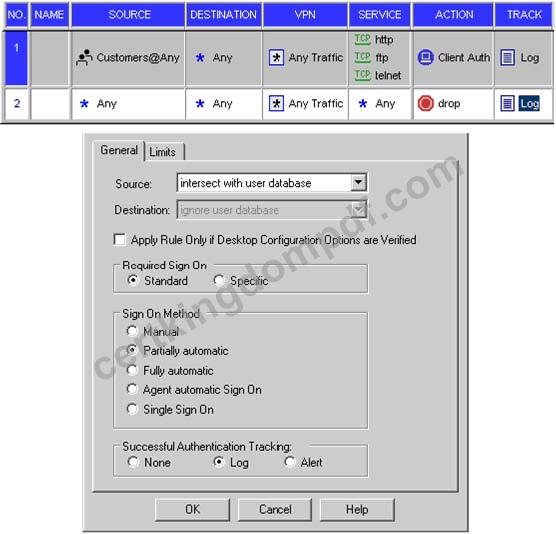
Checkpoint 156-215.75 : Practice Test
After being authenticated by the Security Gateway, when a user starts an HTTP connection to a Web site, the user tries to FTP to another site using the command line. What happens to the user? The:
- A. user is prompted from that FTP site only, and does not need to enter his username and password for Client Authentication.
- B. User is prompted for Authentication by the Security Gateway again.
- C. FTP connection is dropped by rules 2.
- D. FTP data connection is dropped after the user is authenticated successfully.
Correct Answer: A 🗳️
Identify the correct step performed by SmartUpdate to upgrade a remote Security Gateway. After selecting Packages / Distribute Only and choosing the target Gateway, the:
- A. selected package is copied from the Package Repository on the Security Management Server to the Security Gateway and the installation IS performed.
- B. selected package is copied from the CD-ROM of the SmartUpdate PC directly to the
Security Gateway and the installation IS performed. - C. selected package is copied from the Package Repository on the Security Management Server to the Security Gateway but the installation IS NOT performed.
- D. SmartUpdate wizard walks the Administrator through a distributed installation.
Correct Answer: C 🗳️
Review the following rules. Assume domain UDP is enabled in the implied rules.
What happens when a user from the internal network tries to browse to the Internet using HTTP? The user:
- A. can go to the Internet after Telnetting to the client auth daemon port 259.
- B. is prompted three times before connecting to the Internet successfully.
- C. can go to the Internet, without being prompted for authentication.
- D. can connect to the Internet successfully after being authenticated.
Correct Answer: C 🗳️
NAT can NOT be configured on which of the following objects?
- A. Address Range
- B. Host
- C. Gateway
- D. HTTP Logical Server
Correct Answer: D 🗳️
Viewing page 1 out of 109 pages.
Viewing questions 1-5 out of 543 questions.


 Darren

 Eudora

 Heather
 Kerwin
 Jamie

 Herman
 Kerr
 John
 Kirk
 Upton
 Jeff
 Timothy
 Asa
 Grace
 Cliff
 Agnes
 Xaviera
 Emma
 Aurora
 Wythe
 Tabitha


