


Latest AZ-120 Exam Dumps Microsoft Exam from Training Expert CertkingdomPDF
Pass Microsoft Planning and Administering Microsoft Azure for SAP Workloads PDF Dumps | Recently Updated 283 Questions
Microsoft AZ-120 exam covers various topics, including planning and deploying SAP solutions on Azure, migrating SAP workloads to Azure, managing SAP HANA on Azure, and monitoring and troubleshooting Azure infrastructure. AZ-120 exam also evaluates the candidate's knowledge of Azure Virtual Machines, Azure Storage, Azure Networking, and Azure Security. Planning and Administering Microsoft Azure for SAP Workloads certification exam is designed to ensure that candidates have a comprehensive understanding of Azure infrastructure and SAP workloads.
NEW QUESTION # 57
HOTSPOT
For each of the following statements, select Yes if the statement is true. Otherwise, select No.
NOTE: Each correct selection is worth one point.
Hot Area:
Answer:
Explanation:
Explanation:
Box 1: Yes
The SAP Azure Enhanced Monitoring Extension builds on top of the Azure Diagnostic extension, which stores its data in an Azure Storage account that you specify.
Box 2: Yes
The Set-AzVMAEMExtension cmdlet updates the configuration of a virtual machine to enable or update the support for monitoring for SAP systems that are installed on the virtual machine. The cmdlet installs the Azure Enhanced Monitoring (AEM) extension that collects the performance data and makes it discoverable for the SAP system.
The -OSType specifies the OS. Either Windows or Linux.
Box 3: Yes
Reference:
https://docs.microsoft.com/en-us/azure/azure-monitor/platform/diagnostics-extension-overview
https://docs.microsoft.com/en-us/powershell/module/az.compute/set-azvmaemextension
NEW QUESTION # 58
You plan to deploy two SAP NetWeaver landscapes named Production1 and Production2 to Azure.
Production! will contain an SAP NetWeaver central services (ASCS/SCS) instance hosted on a Windows failover cluster. Production2 will contain an SAP ASCS/SCS instance hosted on a Linux Pacemaker cluster.
You need to recommend a shared storage solution for each landscape. The solutions must meet the following requirements:
* Minimize administrative effort.
* Minimize costs.
What should you include in the recommend? To answer, select the appropriate options in the answer area.
NOTE: Each correct selection is worth one point.
Answer:
Explanation:
Explanation
NEW QUESTION # 59
You have an SAP environment on Azure.
You use Azure Recovery Services to back up an SAP application server.
You need to test the restoration process of a file on the server.
Which three actions should you perform in sequence? To answer, move the appropriate actions from the list of actions to the answer area and arrange them in the correct order.
Answer:
Explanation:
Explanation:
Step 1: From Azure Recover Vault, select File Recovery
To restore files or folders from the recovery point, go to the virtual machine and choose the desired recovery point.
Step 2: Download and run the mount disk executable
Step 3: recover the file and unmount the disk
NEW QUESTION # 60
Before putting the SAP environment on Azure into production, which command should you run to ensure that the virtual machine disks meet the business requirements? To answer, select the appropriate options in the answer area.
NOTE: Each correct selection is worth one point.
Answer:
Explanation:
NEW QUESTION # 61
You have an on-premises deployment of SAP on DB2.
You plan to migrate the deployment to Azure and Microsoft SQL Server 2017.
What should you use to migrate the deployment?
- A. Azure SQL Data Sync
- B. DSN1COPY
- C. db2haicu
- D. SQL Server Migration Assistant (SSMA)
Answer: D
NEW QUESTION # 62
You need direct connectivity from an on-premises network to SAP HANA (Large Instances). The solution must meet the following requirements:
Minimize administrative effort.
Provide the highest level of resiliency.
What should you use?
- A. Linux IPTables
- B. ExpressRoute
- C. ExpressRoute Global Reach
- D. NGINX as a reverse proxy
Answer: B
Explanation:
https://docs.microsoft.com/en-us/azure/virtual-machines/workloads/sap/hana-network-architecture Express Route Global Reach Microsoft introduced a new functionality called ExpressRoute Global Reach. Global Reach can be used for HANA Large Instances in two scenarios: Enable direct access from on-premises to your HANA Large Instance units deployed in different regions Enable direct communication between your HANA Large Instance units deployed in different regions Direct Access from on-premises In the Azure regions where Global Reach is offered, you can request enabling the Global Reach functionality for your ExpressRoute circuit that connects your on-premises network to the Azure virtual network that connects to your HANA Large Instance units as well.
NEW QUESTION # 63
This question requires that you evaluate the underlined BOLD text to determine if it is correct.
You are planning for the administration of resources in Azure.
To meet the technical requirements, you must first implement Active Directory Federation Services (AD FS).
Instructions: Review the underlined text. If it makes the statement correct, select "No change is needed". If the statement is incorrect, select the answer choice that makes the statement correct.
- A. Enterprise State Roaming
- B. No change is needed
- C. Azure AD join
- D. Azure AD Connect
Answer: D
Explanation:
AD connect, it's not mandatory to have AD FS, you can use Password HAsh Synch or Passthrough Authentication, but AD Connect is mandatory to synch you on-promises accounts to Azure AD Reference:
https://docs.microsoft.com/en-us/azure/active-directory/saas-apps/sap-hana-cloud-platform-identity-authentication-tutorial
NEW QUESTION # 64
You plan to deploy a scale-out SAP HANA deployment on Azure virtual machines that will contain a standby node.
You need to recommend a storage solution for the deployment.
What should you recommend? To answer, select the appropriate options in the answer area.
NOTE: Each correct selection is worth one point
Answer:
Explanation:
Explanation
NEW QUESTION # 65
For each of the following statements, select Yes if the statement is true. Otherwise, select No.
NOTE Each correct selection is worth one point.
Answer:
Explanation:
Explanation:
NEW QUESTION # 66
You have an SAP production landscape on Azure that contains the resources shown in the following table.
You need to stop the SAP services so that you can perform monthly maintenance.
Which command should you run from the Azure Cloud Shell? To answer, select the appropriate options in the answer area NOTE: Each correct selection is worth one point.
Answer:
Explanation:
Explanation:
NEW QUESTION # 67
For each of the following statements, select yes if the statement is true. Otherwise, select No.
NOTE: Each correct selection is worth one point.
Answer:
Explanation:
Explanation
NEW QUESTION # 68
You plan to deploy an SAP environment on Azure. The SAP environment will have landscapes for production, development. and quality assurance.
You need to minimize the costs associated with running the development and quality assurance landscapes on Azure. What should you do?
- A. Create Azure Automation runbooks to stop, deallocate, and start Azure virtual machines.
- B. Configure Azure virtual machine scales sets.
- C. Create a scheduled task that runs the stopsap command.
- D. Configure scaling for Azure App Service.
Answer: A
Explanation:
You can optimize your Azure Costs by Automating SAP System Start - Stop using runbooks.
Reference:
https://techcommunity.microsoft.com/t5/running-sap-applications-on-the/optimize-your-azure-costs-by-automati
NEW QUESTION # 69
For each of the following statements, select Yes if the stamen is true. Otherwise, select No.
NOTE: Each correct selection is worth one point.
Answer:
Explanation:
NEW QUESTION # 70
You have an SAP on Azure deployment that contains a production landscape, a development landscape, and a quality assurance landscape. All the landscapes are hosted on Azure virtual machines.
You need to create a monthly report that identifies opportunities for performance and security optimization. The solution must minimize administrative effort What should you use?
- A. SAP HANA hardware and cloud measurement tools
- B. SAP GUI
- C. Azure Advisor
- D. Azure Monitor
Answer: C
NEW QUESTION # 71
You deploy an SAP environment on Azure.
You need to configure SAP NetWeaver to authenticate by using Azure Active Directory (Azure AD).
Which four actions should you perform in sequence? To answer, move the appropriate actions from the list of actions to the answer area and arrange them in the correct order.
Answer:
Explanation:
NEW QUESTION # 72
For each of the following statements, select Yes if the statement is true. Otherwise, select No.
NOTE: Each correct selection is worth one point.
Answer:
Explanation:
Explanation:
Box 1: Yes
By moving much of Azure's software-defined networking stack off the CPUs and into FPGA-based SmartNICs, compute cycles are reclaimed by end user applications, putting less load on the VM, decreasing jitter and inconsistency in latency.
Box 2: Yes
Box 3: No
Accelerated Networking (AN) is generally available (GA) and widely available for Windows and the latest distributions of Linux References:
https://azure.microsoft.com/en-us/blog/maximize-your-vm-s-performance-with-accelerated-networking-now-gen
https://azure.microsoft.com/en-gb/blog/maximize-your-vm-s-performance-with-accelerated-networking-now-gen
NEW QUESTION # 73
For each of the following statements, select Yes if the statement is true. Otherwise, select No.
NOTE: Each correct selection is worth one point.
Answer:
Explanation:
Explanation
Box 1: No
To log in to a Linux VM with Azure AD credentials, install the Azure Active Directory login VM extension.
Note: Azure AD Connect is the Microsoft tool designed to meet and accomplish your hybrid identity goals.
Box 2: NO
Box 3: No
References:
https://docs.microsoft.com/en-us/azure/virtual-machines/workloads/sap/deployment-guide
NEW QUESTION # 74
You are planning replication of the SAP HANA database for the disaster recovery environment in Azure.
For each of the following statements, select Yes if the statement is true. Otherwise, select No.
NOTE: Each correct selection is worth one point.
Answer:
Explanation:
Explanation:
Box 1: No
SAP HANA Replication consists of one primary node and at least one secondary node. Changes to the data on the primary node are replicated to the secondary node synchronously or asynchronously.
Box 2: No
Since SPS11 SAP HANA system replication can be run in two different operation modes:
delta_datashipping
logreplay
Box 3: Yes
Reference:
https://docs.microsoft.com/en-us/azure/virtual-machines/workloads/sap/sap-hana-high-availability-rhel
https://blogs.sap.com/2018/01/08/your-sap-on-azure-part-4-high-availability-for-sap-hana-using-system-replicati
NEW QUESTION # 75
You have an Azure subscription that contains a virtual network named VNET1, an SAP production landscape on Azure, and an SAP non-production landscape on Azure. Both landscapes connect to VNET1. Each landscape contains virtual machines that run the following:
* SAPHANA
* SAP NetWeaver
* Microsoft SQL Server
You need to monitor the landscapes. The solution must minimize costs.
What is the minimum number of required Azure Monitor for SAP Solutions instances?
- A. 0
- B. 1
- C. 2
- D. 3
Answer: A
NEW QUESTION # 76
You have an on-premises SAP environment that uses AIX servers and IBM DB2 as the database platform.
You plan to migrate SAP to Azure. In Azure, the SAP workloads will use Windows Server and Microsoft SQL Server as the database platform.
What should you use to export from DB2 and import the data to SQL Server?
- A. R3trans
- B. SQL Server Management Studio (SSMS)
- C. Azure SQL Data Warehouse
- D. R3load
Answer: D
Explanation:
Both R3load and SSMA can be used to migrate from DB2 to SQL Server. In the options there is not SSMA, but SSMS, the SSMS cannot be use to migrate DB2 to SQL Server. please refer to: https://techcommunity.microsoft.com/t5/running-sap-applications-on-the/sap-os-db-migration-to-sql-server-faq/ba-p/366986
https://sapnwnewbie.blogspot.com/2013/07/osdb-migration-cmd-str-toc-ext-r3load.html https://docs.microsoft.com/en-us/sql/ssma/sql-server-migration-assistant?view=sql-server-ver15
https://docs.microsoft.com/en-us/sql/ssms/sql-server-management-studio-ssms?view=sql-server-ver15
NEW QUESTION # 77
A customer that has a large enterprise SAP environment plans to migrate to Azure. The environment uses servers that run Windows Server 2016 and Microsoft SQL Server.
The environment is critical and requires a comprehensive business continuity and disaster recovery (BCDR) strategy that minimizes the recovery point objective (RPO) and the recovery time objective (RTO).
The customer wants a resilient environment that has a secondary site that is at least 250 kilometers away.
You need to recommend a solution for the customer.
Which two solutions should you recommend? Each correct answer presents part of the solution.
NOTE: Each correct selection is worth one point.
- A. warm standby virtual machines in an Azure Availability Set that uses geo-redundant storage (GRS)
- B. warm standby virtual machines in paired regions
- C. an internal load balancer to route Internet traffic
- D. Azure Traffic Manager to route incoming traffic
- E. warm standby virtual machines in Azure Availability Zones
Answer: A,B
Explanation:
A: An Azure Region Pair is a relationship between two Azure Regions within the same geographic region for disaster recovery purposes. If one of the regions were to experience a disaster or failure, then the services in that region will automatically failover to that regions secondary region in the pair.
C: For increased availability, you can deploy two VMs with two HANA instances within an Azure availability set that uses HANA system replication for availability.
References:
https://docs.microsoft.com/en-us/azure/virtual-machines/workloads/sap/sap-hana-availability-one-region
NEW QUESTION # 78
Your company has a an on-premises SAP environment.
Recently, the company split into two companies named Litware, inc and Contoso.Ltd. Litware retained the SAP environment.
Litware plans to export data that is relevant only to Contoso. The export will be 1.5 TB.
Contoso build a new SAP environment on Azure.
You need to recommend a solution for Litware to make the data available to Contoso in Azure. The solution must meet the following requirements:
Minimize the impact on the network.
Minimize the administrative effort for Litware.
What should you include in the recommendation.
- A. Azure import/Export service
- B. Azure Site Recovery
- C. Azure Databox
- D. Azure Migrate
Answer: B
NEW QUESTION # 79
For each of the following statements, select Yes if the statement is true. Otherwise, select No. NOTE: Each correct selection is worth one point.
Answer:
Explanation:
Explanation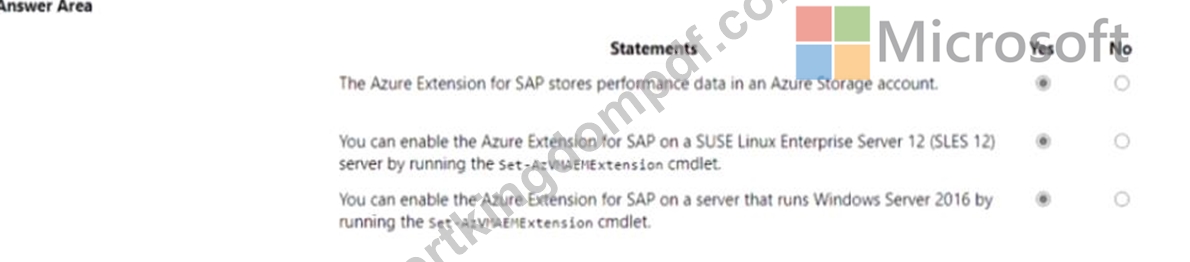
NEW QUESTION # 80
You have an on-premises SAP environment.
Backups are performed by using tape backups. There are SO TB of backups.
A Windows file server has BMP images of checks used by SAP Finance. There are 9 IB of images.
You need to recommend a method to migrate the images and the tape backups to Azure. The solution must maintain continuous replication of the images.
What should you include in the recommendation? To answer, select the appropriate options in the answer area.
NOTE: Each correct selection is worth one point.
Answer:
Explanation:
Explanation
Tape Backups - Azure Databox
File Server - Azure Storage Explorer
NEW QUESTION # 81
You plan to deploy a highly available ASCS instance to SUSE Linux Enterprise Server (SLES) virtual machines in Azure.
You are configuring an internal Azure Standard Load Balancer for the ASCS instance.
How should you configure the internal Standard Load Balancer? To answer, select the appropriate options in the answer area.
NOTE: Each correct selection is worth one point.
Answer:
Explanation:
Reference:
https://docs.microsoft.com/en-us/azure/virtual-machines/workloads/sap/high-availability-guide-suse
NEW QUESTION # 82
......
Microsoft AZ-120 exam covers a wide range of topics, including planning and deploying Azure for SAP workloads, configuring Azure infrastructure for SAP workloads, managing and monitoring SAP workloads on Azure, and optimizing the performance of SAP workloads on Azure. Candidates are expected to have a deep understanding of SAP architecture and operations, as well as experience with Azure services such as virtual machines, storage, networking, and security. AZ-120 exam consists of 40-60 multiple-choice questions and is available in multiple languages.
Updated Test Engine to Practice AZ-120 Dumps & Practice Exam: https://www.certkingdompdf.com/AZ-120-latest-certkingdom-dumps.html
Dumps Collection AZ-120 Test Engine Dumps Training With 283 Questions: https://drive.google.com/open?id=1JT0-zKHE6uF6mPjo38uBZ45dSXwZOON3