


Get New 2021 Microsoft exam AZ-204 Dumps Bundle On flat Updated Dumps!
Full AZ-204 Practice Test and 257 unique questions with explanations waiting just for you, get it now!
NEW QUESTION 54
You are a developer for a software as a service (SaaS) company that uses an Azure Function to process orders. The Azure Function currently runs on an Azure Function app that is triggered by an Azure Storage queue.
You are preparing to migrate the Azure Function to Kubernetes using Kubernetes-based Event Driven Autoscaling (KEDA).
You need to configure Kubernetes Custom Resource Definitions (CRD) for the Azure Function.
Which CRDs should you configure? To answer, drag the appropriate CRD types to the correct locations.
Each CRD type may be used once, more than once, or not at all. You may need to drag the split bar between panes or scroll to view content.
NOTE: Each correct selection is worth one point.
Answer:
Explanation:
Explanation
Box 1: Deployment
To deploy Azure Functions to Kubernetes use the func kubernetes deploy command has several attributes that directly control how our app scales, once it is deployed to Kubernetes.
Box 2: ScaledObject
With --polling-interval, we can control the interval used by KEDA to check Azure Service Bus Queue for messages.
Example of ScaledObject with polling interval
apiVersion: keda.k8s.io/v1alpha1
kind: ScaledObject
metadata:
name: transformer-fn
namespace: tt
labels:
deploymentName: transformer-fn
spec:
scaleTargetRef:
deploymentName: transformer-fn
pollingInterval: 5
minReplicaCount: 0
maxReplicaCount: 100
Box 3: Secret
Store connection strings in Kubernetes Secrets.
Example: to create the Secret in our demo Namespace:
# create the k8s demo namespace
kubectl create namespace tt
# grab connection string from Azure Service Bus
KEDA_SCALER_CONNECTION_STRING=$(az servicebus queue authorization-rule keys list \
-g $RG_NAME \
--namespace-name $SBN_NAME \
--queue-name inbound \
-n keda-scaler \
--query "primaryConnectionString" \
-o tsv)
# create the kubernetes secret
kubectl create secret generic tt-keda-auth \
--from-literal KedaScaler=$KEDA_SCALER_CONNECTION_STRING \
--namespace tt
Reference:
https://www.thinktecture.com/en/kubernetes/serverless-workloads-with-keda/
NEW QUESTION 55
You need to add markup at line AM04 to implement the ContentReview role.
How should you complete the markup? To answer, drag the appropriate json segments to the correct locations.
Each json segment may be used once, more than once, or not at all. You may need to drag the split bar between panes or scroll to view content.
NOTE: Each correct selection is worth one point.
Answer:
Explanation:
Explanation
Box 1: allowedMemberTypes
allowedMemberTypes specifies whether this app role definition can be assigned to users and groups by setting to "User", or to other applications (that are accessing this application in daemon service scenarios) by setting to "Application", or to both.
Note: The following example shows the appRoles that you can assign to users.
"appId": "8763f1c4-f988-489c-a51e-158e9ef97d6a",
"appRoles": [
{
"allowedMemberTypes": [
"User"
],
"displayName": "Writer",
"id": "d1c2ade8-98f8-45fd-aa4a-6d06b947c66f",
"isEnabled": true,
"description": "Writers Have the ability to create tasks.",
"value": "Writer"
}
],
"availableToOtherTenants": false,
Box 2: User
Scenario: In order to review content a user must be part of a ContentReviewer role.
Box 3: value
value specifies the value which will be included in the roles claim in authentication and access tokens.
Reference:
https://docs.microsoft.com/en-us/graph/api/resources/approle
NEW QUESTION 56
You are creating a script that will run a large workload on an Azure Batch pool. Resources will be reused and do not need to be cleaned up after use.
You have the following parameters:
You need to write an Azure CLI script that will create the jobs, tasks, and the pool.
In which order should you arrange the commands to develop the solution? To answer, move the appropriate commands from the list of command segments to the answer area and arrange them in the correct order.
Answer:
Explanation:
1 - az batch pool create
2 - az batch job create
3 - az batch task create
4 - for i in {1..$numberOfJobs} do
References:
https://docs.microsoft.com/bs-latn-ba/azure/batch/scripts/batch-cli-sample-run-job
NEW QUESTION 57
Note: This question is part of a series of questions that present the same scenario. Each question in the series contains a unique solution that might meet the stated goals. Some question sets might have more than one correct solution, while others might not have a correct solution.
After you answer a question in this section, you will NOT be able to return to it. As a result, these questions will not appear in the review screen.
You are developing an Azure Service application that processes queue data when it receives a message from a mobile application. Messages may not be sent to the service consistently.
You have the following requirements:
* Queue size must not grow larger than 80 gigabytes (GB).
* Use first-in-first-out (FIFO) ordering of messages.
* Minimize Azure costs.
You need to implement the messaging solution.
Solution: Use the .Net API to add a message to an Azure Service Bus Queue from the mobile application.
Create an Azure Windows VM that is triggered from Azure Service Bus Queue.
Does the solution meet the goal?
- A. No
- B. Yes
Answer: A
Explanation:
Don't use a VM, instead create an Azure Function App that uses an Azure Service Bus Queue trigger.
Reference:
https://docs.microsoft.com/en-us/azure/azure-functions/functions-create-storage-queue-triggered-function
NEW QUESTION 58
Note: This question is part of a series of questions that present the same scenario. Each question in the series contains a unique solution. Determine whether the solution meets the stated goals.
You are developing and deploying several ASP.Net web applications to Azure App Service. You plan to save session state information and HTML output. You must use a storage mechanism with the following requirements:
* Share session state across all ASP.NET web applications
* Support controlled, concurrent access to the same session state data for multiple readers and a single writer
* Save full HTTP responses for concurrent requests
You need to store the information.
Proposed Solution: Deploy and configure an Azure Database for PostgreSQL. Update the web applications.
Does the solution meet the goal?
- A. No
- B. Yes
Answer: A
Explanation:
Instead deploy and configure Azure Cache for Redis. Update the web applications.
Reference:
https://docs.microsoft.com/en-us/azure/architecture/best-practices/caching#managing-concurrency-in-a-cache
NEW QUESTION 59
You are developing an Azure Durable Function instance. You need to add a delay by using a durable timer.
What type of function should you use?
- A. Activity
- B. Client
- C. Orchestrator
- D. Webhook
Answer: C
Explanation:
Durable Functions provides durable timers for use in orchestrator functions to implement delays or to set up timeouts on async actions.
References:
https://docs.microsoft.com/en-us/azure/azure-functions/durable/durable-functions-overview
NEW QUESTION 60
You need to support the requirements for the Shipping Logic App.
What should you use?
- A. Site-to-Site (S2S) VPN connection
- B. Azure Active Directory Application Proxy
- C. On-premises Data Gateway
- D. Point-to-Site (P2S) VPN connection
Answer: C
Explanation:
Explanation
Before you can connect to on-premises data sources from Azure Logic Apps, download and install the on-premises data gateway on a local computer. The gateway works as a bridge that provides quick data transfer and encryption between data sources on premises (not in the cloud) and your logic apps.
The gateway supports BizTalk Server 2016.
Note: Microsoft have now fully incorporated the Azure BizTalk Services capabilities into Logic Apps and Azure App Service Hybrid Connections.
Logic Apps Enterprise Integration pack bring some of the enterprise B2B capabilities like AS2 and X12, EDI standards support Scenario: The Shipping Logic app must meet the following requirements:
* Support the ocean transport and inland transport workflows by using a Logic App.
* Support industry-standard protocol X12 message format for various messages including vessel content details and arrival notices.
* Secure resources to the corporate VNet and use dedicated storage resources with a fixed costing model.
* Maintain on-premises connectivity to support legacy applications and final BizTalk migrations.
Reference:
https://docs.microsoft.com/en-us/azure/logic-apps/logic-apps-gateway-install
Topic 1, Windows Server 2016 virtual machine
Case study
This is a case study. Case studies are not timed separately. You can use as much exam time as you would like to complete each case. However, there may be additional case studies and sections on this exam. You must manage your time to ensure that you are able to complete all questions included on this exam in the time provided.
To answer the questions included in a case study, you will need to reference information that is provided in the case study. Case studies might contain exhibits and other resources that provide more information about the scenario that is described in the case study. Each question is independent of the other questions in this case study.
At the end of this case study, a review screen will appear. This screen allows you to review your answers and to make changes before you move to the next section of the exam. After you begin a new section, you cannot return to this section.
To start the case study
To display the first question in this case study, click the button. Use the buttons in the left pane to explore the content of the case study before you answer the questions. Clicking these buttons displays information such as business requirements, existing environment, and problem statements. If the case study has an All Information tab, note that the information displayed is identical to the information displayed on the subsequent tabs. When you are ready to answer a question, click the button to return to the question.
Current environment
Windows Server 2016 virtual machine
The virtual machine (VM) runs BizTalk Server 2016. The VM runs the following workflows:
* Ocean Transport - This workflow gathers and validates container information including container contents and arrival notices at various shipping ports.
* Inland Transport - This workflow gathers and validates trucking information including fuel usage, number of stops, and routes.
The VM supports the following REST API calls:
* Container API - This API provides container information including weight, contents, and other attributes.
* Location API - This API provides location information regarding shipping ports of call and tracking stops.
* Shipping REST API - This API provides shipping information for use and display on the shipping website.
Shipping Data
The application uses MongoDB JSON document storage database for all container and transport information.
Shipping Web Site
The
site displays shipping container tracking information and container contents. The site is located at
http://shipping.wideworldimporters.com/
Proposed solution
The on-premises shipping application must be moved to Azure. The VM has been migrated to a new Standard_D16s_v3 Azure VM by using Azure Site Recovery and must remain running in Azure to complete the BizTalk component migrations. You create a Standard_D16s_v3 Azure VM to host BizTalk Server. The Azure architecture diagram for the proposed solution is shown below:
Requirements
Shipping Logic app
The Shipping Logic app must meet the following requirements:
* Support the ocean transport and inland transport workflows by using a Logic App.
* Support industry-standard protocol X12 message format for various messages including vessel content details and arrival notices.
* Secure resources to the corporate VNet and use dedicated storage resources with a fixed costing model.
* Maintain on-premises connectivity to support legacy applications and final BizTalk migrations.
Shipping Function app
Implement secure function endpoints by using app-level security and include Azure Active Directory (Azure AD).
REST APIs
The REST API's that support the solution must meet the following requirements:
* Secure resources to the corporate VNet.
* Allow deployment to a testing location within Azure while not incurring additional costs.
* Automatically scale to double capacity during peak shipping times while not causing application downtime.
* Minimize costs when selecting an Azure payment model.
Shipping data
Data migration from on-premises to Azure must minimize costs and downtime.
Shipping website
Use Azure Content Delivery Network (CDN) and ensure maximum performance for dynamic content while minimizing latency and costs.
Issues
Windows Server 2016 VM
The VM shows high network latency, jitter, and high CPU utilization. The VM is critical and has not been backed up in the past. The VM must enable a quick restore from a 7-day snapshot to include in-place restore of disks in case of failure.
Shipping website and REST APIs
The following error message displays while you are testing the website:
Failed
to load http://test-shippingapi.wideworldimporters.com/: No
'Access-Control-Allow-Origin' header is present on the requested resource. Origin '
http://test.wideworldimporters.com/' is therefore not allowed access.
NEW QUESTION 61
You are deploying an Azure Kubernetes Services (AKS) cluster that will use multiple containers.
You need to create the cluster and verify that the services for the containers are configured correctly and available.
Which four commands should you use to develop the solution? To answer, move the appropriate command segments from the list of command segments to the answer area and arrange them in the correct order.
Answer:
Explanation:
1 - az group create
2 - az aks create
3 - kubectl apply
4 - az aks get-credentials
References:
https://docs.bitnami.com/azure/get-started-aks/
NEW QUESTION 62
You are developing an ASP.NET Core website that uses Azure FrontDoor. The website is used to build custom weather data sets for researchers. Data sets are downloaded by users as Comma Separated Value (CSV) files. The data is refreshed every 10 hours.
Specific files must be purged from the FrontDoor cache based upon Response Header values.
You need to purge individual assets from the Front Door cache.
Which type of cache purge should you use?
- A. root domain
- B. wildcard
- C. single path
Answer: C
NEW QUESTION 63
You have an application that uses Azure Blob storage.
You need to update the metadata of the blobs.
Which three methods should you use to develop the solution? To answer, move the appropriate methods from the list of methods to the answer area and arrange them in the correct order.
Answer:
Explanation:
Reference:
https://docs.microsoft.com/en-us/azure/storage/blobs/storage-blob-properties-metadata
NEW QUESTION 64
Note: This question is part of a series of questions that present the same scenario. Each question in the series contains a unique solution that might meet the stated goals. Some question sets might have more than one correct solution, while others might not have a correct solution.
After you answer a question in this question, you will NOT be able to return to it. As a result, these questions will not appear in the review screen.
Margie's Travel is an international travel and bookings management service. The company is expanding into restaurant bookings. You are tasked with implementing Azure Search for the restaurants listed in their solution.
You create the index in Azure Search.
You need to import the restaurant data into the Azure Search service by using the Azure Search .NET SDK.
Solution:
1. Create a SearchServiceClient object to connect to the search index.
2. Create a DataContainer that contains the documents which must be added.
3. Create a DataSource instance and set its Container property to the DataContainer.
4. Set the DataSources property of the SearchServiceClient.
Does the solution meet the goal?
- A. No
- B. Yes
Answer: A
Explanation:
Use the following method:
1. - Create a SearchIndexClient object to connect to the search index
2. - Create an IndexBatch that contains the documents which must be added.
3. - Call the Documents.Index method of the SearchIndexClient and pass the IndexBatch.
References:
https://docs.microsoft.com/en-us/azure/search/search-howto-dotnet-sdk
NEW QUESTION 65
You are using Azure Front Door Service.
You are expecting inbound files to be compressed by using Brotli compression. You discover that inbound XML files are not compressed. The files are 9 megabytes (MB) in size.
You need to determine the root cause for the issue.
To answer, select the appropriate options in the answer area.
NOTE: Each correct selection is worth one point.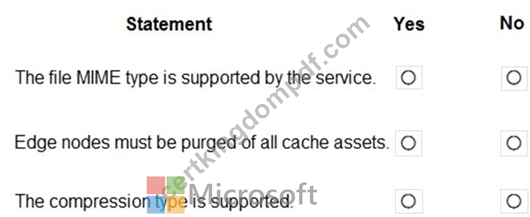
Answer:
Explanation:
Reference:
https://docs.microsoft.com/en-us/azure/frontdoor/front-door-caching
NEW QUESTION 66
You are developing an ASP.NET Core Web API web service that uses Azure Application Insights to monitor performance and track events.
You need to enable logging and ensure that log messages can be correlated to events tracked by Application Insights.
How should you complete the code? To answer, drag the appropriate code segments to the correct locations.
Each code segment may be used once, more than once, or not at all. You may need to drag the split bar between panes or scroll to view content.
NOTE: Each correct selection is worth one point.
Answer:
Explanation:
Explanation
Box 1: ApplicationInsightsLoggerOptions
If you want to include the EventId and EventName properties, then add the following to the ConfigureServices method:
services
AddOptions<ApplicationInsightsLoggerOptions>()
Configure(o => o.IncludeEventId = true);
Box 2: IncludeEventID
Box 3: ApplicationServices
In Asp.Net core apps it turns out that trace logs do not show up in Application Insights out of the box. We need to add the following code snippet to our Configure method in Startup.cs:
loggerFactory.AddApplicationInsights(app.ApplicationServices, logLevel); References:
https://blog.computedcloud.com/enabling-application-insights-trace-logging-in-asp-net-core/
NEW QUESTION 67
You are developing a .NET Core MVC application for customers to research hotels. The application will use Azure Search. The application will search the index by using various criteria to locate documents related to hotels. The index will include search fields for rate, a list of amenities, and distance to the nearest airport.
The application must support the following scenarios for specifying search criteria and organizing results:
* Search the index by using regular expressions.
* Organize results by counts for name-value pairs.
* List hotels within a specified distance to an airport and that fall within a specific price range.
You need to configure the SearchParameters class.
Which properties should you configure? To answer, select the appropriate options in the answer area.
NOTE Each correct selection is worth one point.
Answer:
Explanation:
References:
https://docs.microsoft.com/en-us/dotnet/api/microsoft.azure.search.models.searchparameters
https://docs.microsoft.com/en-us/azure/search/query-lucene-syntax
https://docs.microsoft.com/en-us/dotnet/api/microsoft.azure.search.models.searchparameters.querytype
NEW QUESTION 68
You are debugging an application that is running on Azure Kubernetes cluster named cluster1. The cluster uses Azure Monitor for containers to monitor the cluster.
The application has sticky sessions enabled on the ingress controller.
Some customers report a large number of errors in the application over the last 24 hours.
You need to determine on which virtual machines (VMs) the errors are occurring.
How should you complete the Azure Monitor query? To answer, select the appropriate options in the answer area.
NOTE: Each correct selection is worth one point.
Answer:
Explanation:
Explanation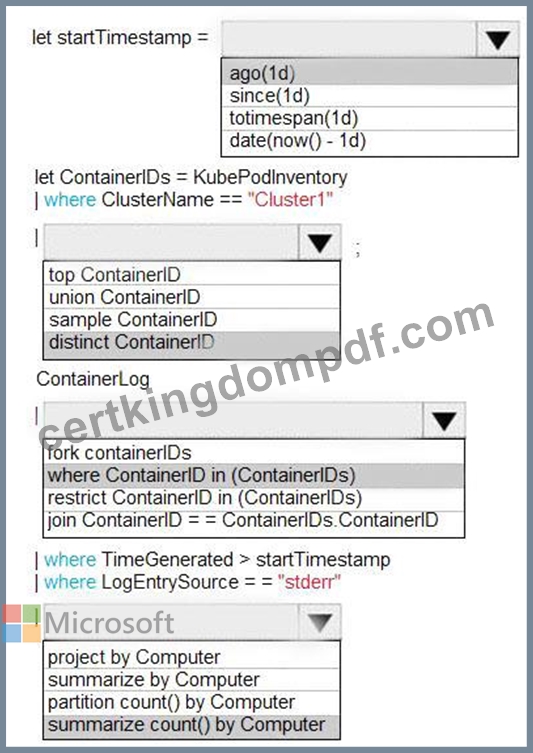
Box 1: ago(1d)
Box 2: distinct containerID
Box 3: where ContainerID in (ContainerIDs)
Box 4: summarize Count by Computer
Summarize: aggregate groups of rows
Use summarize to identify groups of records, according to one or more columns, and apply aggregations to them. The most common use of summarize is count, which returns the number of results in each group.
Reference:
https://docs.microsoft.com/en-us/azure/azure-monitor/log-query/get-started-queries
https://docs.microsoft.com/en-us/azure/azure-monitor/log-query/query-optimization
NEW QUESTION 69
Contoso, Ltd. provides an API to customers by using Azure API Management (APIM). The API authorizes users with a JWT token.
You must implement response caching for the APIM gateway. The caching mechanism must detect the user ID of the client that accesses data for a given location and cache the response for that user ID.
You need to add the following policies to the policies file:
* a set-variable policy to store the detected user identity
* a cache-lookup-value policy
* a cache-store-value policy
* a find-and-replace policy to update the response body with the user profile information To which policy section should you add the policies? To answer, drag the appropriate sections to the correct policies. Each section may be used once, more than once, or not at all. You may need to drag the split bar between panes or scroll to view content NOTE: Each correct selection is worth one point
Answer:
Explanation:
Reference:
https://docs.microsoft.com/en-us/azure/api-management/api-management-caching-policies
https://docs.microsoft.com/en-us/azure/api-management/api-management-sample-cache-by-key
NEW QUESTION 70
You develop a gateway solution for a public facing news API.
The news API back end is implemented as a RESTful sen/ice and hosted in an Azure App Service instance.
You need to configure back-end authentication for the API Management service instance.
Which target and gateway credential type should you use? To answer, drag the appropriate values to the correct parameters. Each value may be used once, more than once, or not at all. You may need to drag the split bar between panes or scroll to view content.
NOTE: Each correct selection is worth one point.
Answer:
Explanation:
Explanation
Box 1: Azure Resource
Box 2: Client cert
API Management allows to secure access to the back-end service of an API using client certificates.
References:
https://docs.microsoft.com/en-us/rest/api/apimanagement/apimanagementrest/azure-api-management-rest-api-b
NEW QUESTION 71
ASP.NET Core API app by using C#. The API app will allow users to authenticate by using Twitter and Azure Active Directory (Azure AD).
Users must be authenticated before calling API methods. You must log the user's name for each method call.
You need to configure the API method calls.
Which values should you use? To answer, select the appropriate options in the answer area.
NOTE: Each correct selection is worth one point.
Answer:
Explanation:
Explanation
+ Explanation:
Box 1: Authorize
Box 2: X-MS-CLIENT-PRINCIPAL-NAME
App Service passes user claims to your application by using special headers. External requests aren't allowed to set these headers, so they are present only if set by App Service. Some example headers include:
X-MS-CLIENT-PRINCIPAL-NAME
X-MS-CLIENT-PRINCIPAL-ID
Here's the set of headers you get from Easy Auth for a Twitter authenticated user:
{
"cookie": "AppServiceAuthSession=Lx43...xHDTA==",
"x-ms-client-principal-name": "evilSnobu",
"x-ms-client-principal-id": "35....",
"x-ms-client-principal-idp": "twitter",
"x-ms-token-twitter-access-token": "35...Dj",
"x-ms-token-twitter-access-token-secret": "OK3...Jx",
}
References:
https://docs.microsoft.com/en-us/azure/app-service/app-service-authentication-how-to
NEW QUESTION 72
You are building a website to access project data related to terms within your organization. The website does not allow anonymous access. Authentication performed using an Azure Active Directory (Azure AD) app named internal.
The website has the following authentication requirements:
*Azure AD users must be able to login to the website.
*Personalization of the website must be based on membership in Active Directory groups.
You need to configure the application's manifest to meet the authentication requirements.
How should you configure the manifest? To answer, select the appropriate options in the answer area.
NOTE: Each correct selection is worth one point.
Answer:
Explanation:
Explanation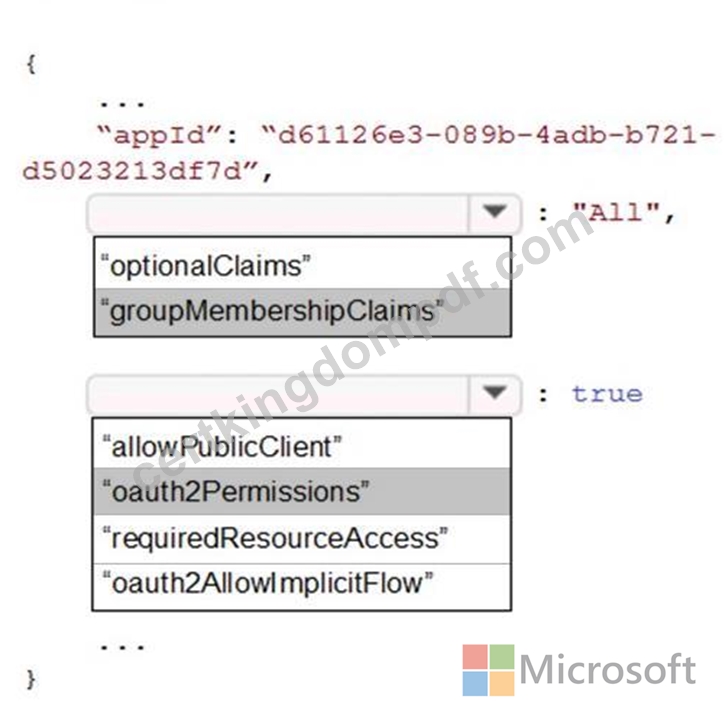
Box 1: groupMembershipClaims
Scenario: Personalization of the website must be based on membership in Active Directory groups.
Group claims can also be configured in the Optional Claims section of the Application Manifest.
Enable group membership claims by changing the groupMembershipClaim
The valid values are:
"All"
"SecurityGroup"
"DistributionList"
"DirectoryRole"
Box 2: oauth2Permissions
Scenario: Azure AD users must be able to login to the website.
oauth2Permissions specifies the collection of OAuth 2.0 permission scopes that the web API (resource) app exposes to client apps. These permission scopes may be granted to client apps during consent.
NEW QUESTION 73
You need to support the message processing for the ocean transport workflow.
Which four actions should you perform in sequence? To answer, move the appropriate actions from the list of actions to the answer area and arrange them in the correct order.
Answer:
Explanation:
Explanation
Step 1: Create an integration account in the Azure portal
You can define custom metadata for artifacts in integration accounts and get that metadata during runtime for your logic app to use. For example, you can provide metadata for artifacts, such as partners, agreements, schemas, and maps - all store metadata using key-value pairs.
Step 2: Link the Logic App to the integration account
A logic app that's linked to the integration account and artifact metadata you want to use.
Step 3: Add partners, schemas, certificates, maps, and agreements
Step 4: Create a custom connector for the Logic App.
References:
https://docs.microsoft.com/bs-latn-ba/azure/logic-apps/logic-apps-enterprise-integration-metadata
NEW QUESTION 74
......
[Sep-2021] Pass Microsoft AZ-204 Exam in First Attempt Guaranteed: https://drive.google.com/open?id=1pQeszKH9z5VyCHE8c_HxxlNJiSGFQd8n
Reduce Your Chance of Failure in AZ-204 Exam: https://www.certkingdompdf.com/AZ-204-latest-certkingdom-dumps.html