


Full 070-768 Practice Test and 70 unique questions with explanations waiting just for you!
MCSA Dumps 070-768 Exam for Full Questions - Exam Study Guide
NEW QUESTION 26
You are optimizing a Microsoft SQL Server Analysis Services (SSAS) multidimensional model over a SQL Server database. You have a table named City which has several dimensions that do not contain a space in their names. One dimension is named
SalesTerritory rather than Sales Territory.
You need to ensure that Report developers can drag the attribute name to the report rather than having to re-label the attributes by implementing spaces. You must minimize administrative effort and not break any upstream processes.
What should you do?
- A. In the SQL Server database, run the system procedure sp_rename to rename the columns in the base tables with the target name.
- B. In the SQL Server database, implement a SYNONYM.
- C. In the SQL Server database, implement a view over the City table that aliases the columns in the tables.
- D. In SQL Server Management Studio, navigate to the City table, expand the columns, press F2, and rename the columns in the base tables.
Answer: C
NEW QUESTION 27
Note: This question is part of a series of questions that present the same scenario. Each question in the series contains a unique solution. Determine whether the solution meets the stated goals.
You deploy a tabular data model to an instance of Microsoft SQL Server Analysis Services
(SSAS). The model uses an in-memory cache to store and query data. The data set is already the same size as the available RAM on the server. Data volumes are likely to continue to increase rapidly.
Your data model contains multiple calculated tables.
The data model must begin processing each day at 2:00 and processing should be complete by 4:00 the same day. You observe that the data processing operation often does not complete before 7:00. This is adversely affecting team members.
You need to improve the performance.
Solution: Enable Buffer Cache Extensions.
Does the solution meet the goal?
- A. No
- B. Yes
Answer: A
Explanation:
In this scenario we would need both Buffer Cache Extensions and SSD.
The buffer pool extension provides the seamless integration of a nonvolatile random access memory (that is, solid-state drive) extension to the Database Engine buffer pool to significantly improve I/O throughput.
References:https://docs.microsoft.com/en-us/sql/database-engine/configure- windows/buffer-pool-extension
NEW QUESTION 28
Note: This question is part of a series of questions that present the same scenario. Each question in the series contains a unique solution. Determine whether the solution meets the stated goals.
You have an existing multidimensional cube that provides sales analysis. The users can slice by date, product, location, customer, and employee.
The management team plans to evaluate sales employee performance relative to sales targets. You identify the following metrics for employees:
Ninety percent or greater relative to sales target values is considered on target.
Between 75 percent and 90 percent is considered slightly off target.
Below 75 percent is considered off target.
You need to implement the KPI based on the Status expression.
Solution: You design the following solution:
Does the solution meet the goal?
- A. No
- B. Yes
Answer: A
Explanation:
Explanation/Reference:
Explanation:
NEW QUESTION 29
You are responsible for installing new database server instances.
You must install Microsoft SQL Server Analysis Services (SSAS) to support deployment of the following projects.
You develop both projects by using SQL Server Data Tools.
You need to install the appropriate services to support both projects.
Which two actions should you perform? Each correct answer presents part of the solution.
- A. Install one multidimensional instance of SSAS.
- B. Install two separate tabular instances of SSAS.
- C. Install one tabular instance of SSAS and enable the Data Mining Extensions.
- D. Install one tabular instance of SSAS.
- E. Install a multidimensional instance and a Power Pivot instance of SSAS on the same server.
Answer: A,D
Explanation:
Analysis Services can be installed in one of three server modes: Multidimensional and Data Mining (default), Power Pivot for SharePoint, and Tabular.
https://docs.microsoft.com/en-us/sql/analysis-services/comparing-tabular-and-multidimensional- solutions-ssas
NEW QUESTION 30
Drag and Drop Question
You need to configure the SalesAnalysis cube to correct the sales analysis by customer calculation.
Which four actions should you perform in sequence? To answer, move the appropriate actions from the list of actions to the answer area and arrange them in the correct order.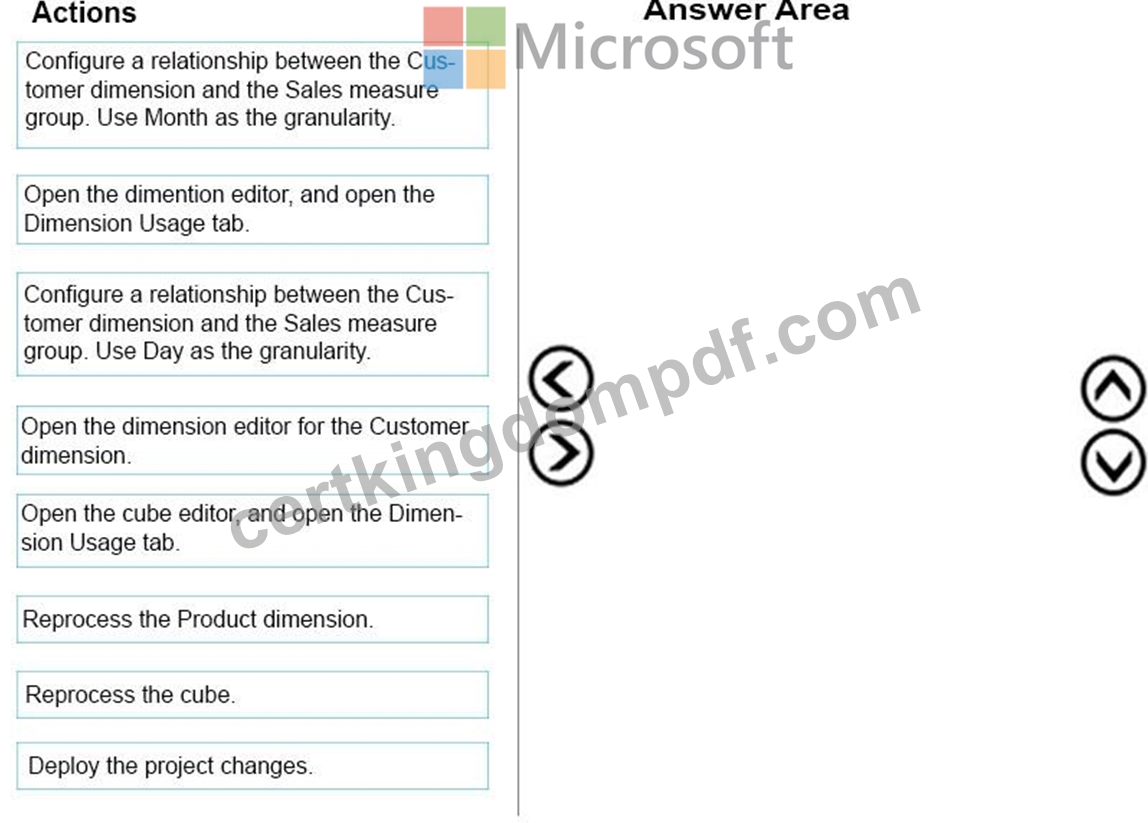
Answer:
Explanation:
Explanation:
Step 1: Open the cube editor, and open the Dimension Usage tab.
Step 2: Configure a relationship between the Customer dimension and the Sales measure group.
Use Day as the granularity.
From scenario: The SalesAnalysis cube contains a fact table named CoffeeSale loaded from a table named FactSale in the data warehouse. The time granularity within the cube is 15 minutes.
The cube is processed every night at 23:00. You determine that the fact table cannot be fully processed in the expected time. Users have reported slow query response times.
Step 3: Reprocess the cube.
Step 4: Deploy the project changes.
Topic 1, Background
Wide World Importers has multidimensional cubes named SalesAnalysis and ProductSales. The SalesAnalysis cube is refreshed from a relational data warehouse. You have a Microsoft SQL Server Analysis Services instance that is configured to use tabular mode. You have a tabular data model named CustomerAnalysis.
Sales Analysis
The SalesAnalysis cube contains a fact table named CoffeeSale loaded from a table named FactSale in the data warehouse. The time granularity within the cube is 15 minutes. The cube is processed every night at 23:00. You determine that the fact table cannot be fully processed in the expected time. Users have reported slow query response times.
The SalesAnalysis model contains tables from a SQL Server database named SalesDB. You set the DirectQueryMode option to DirectQuery. Data analyst access data from a cache that is up to
24 hours old. Data analyst report performance issues when they access the SalesAnalysis model.
When analyzing sales by customer, the total of all sales is shown for every customer, instead of the customer's sales value. When analyzing sales by product, the correct totals for each product are shown.
Customer Analysis
You are redesigning the CustomerAnalysis tabular data model that will be used to analyze customer sales. You plan to add a table named CustomerPermission to the model. This table maps the Active Directory login of an employee with the CustomerId keys for all customers that the employee manages.
The CustomerAnalysis data model will contain a large amount of data and needs to be shared with other developers even if a deployment fails. Each time you deploy a change during development, processing takes a long time.
Data analysts must be able to analyze sales for financial years, financial quarters, months, and days. Many reports are based on analyzing sales by month.
Product Sales
The ProductSales cube allows data analysts to view sales information by product, city, and time.
Data analysts must be able to view ProductSales data by Year to Date (YTD) as a measure. The measure must be formatted as currency, associated with the Sales measure group, and contained in a folder named Calculations.
Requirements
You identify the following requirements:
- Data available during normal business hours must always be up-to-
date.
- Processing overhead must be minimized.
- Query response times must improve.
- All queries that access the SalesAnalysis model must use cached data
by default.
- Data analysts must be able to access data in near real time.
NEW QUESTION 31
Note: This question is part of a series of questions that present the same scenario. Each question in the series contains a unique solution. Determine whether the solution meets the stated goals.
You have an existing multidimensional cube that provides sales analysis. The users can slice by date, product, location, customer, and employee.
The management team plans to evaluate sales employee performance relative to sales targets. You identify the following metrics for employees:
Ninety percent or greater relative to sales target values is considered on target.
Between 75 percent and 90 percent is considered slightly off target.
Below 75 percent is considered off target.
You need to implement the KPI based on the Status expression.
Solution: You design the following solution:
Does the solution meet the goal?
- A. No
- B. Yes
Answer: B
Explanation:
Explanation/Reference:
Explanation:
NEW QUESTION 32
You are a business analyst for a retail company that uses a Microsoft SQL Server Analysis Services (SSAS) multidimensional database for reporting.
The database contains the following objects:
You must create a report that shows, for each month, the Internet sales for that month and the total Internet sales for the calendar year up to and including the current month.
You create the following MDX statement (Line numbers are included for reference only.):
You need to complete the MDX statement to return data for the report.
Which MDX segment should you use in line 01?
Answer:
Explanation:
The following example returns the sum of the Measures. [Order Quantity] member, aggregated over the first eight months of calendar year 2003 that are contained in the Date dimension, from the Adventure Works cube.
Copy
WITH MEMBER [Date].[Calendar].[First8Months2003] AS
Aggregate(
PeriodsToDate(
[Date].[Calendar].[Calendar Year],
[Date].[Calendar].[Month].[August 2003]
)
)
SELECT
[Date].[Calendar].[First8Months2003] ON COLUMNS,
[Product].[Category].Children ON ROWS
FROM
[Adventure Works]
WHERE
[Measures].[Order Quantity]
References: https://docs.microsoft.com/en-us/sql/mdx/aggregate-mdx
NEW QUESTION 33
You are developing and application to track customer sales.
You need to return the sum of orders that have been finalized, given a specified order identifier.
This value will be used in other Transact-SOL statements.
You need to create a database object.
What should you create?
- A. scalar-valued function
- B. DML trigger
- C. table-valued function
- D. user-defined procedure
- E. CLR procedure
- F. extended procedure
Answer: A
NEW QUESTION 34
DRAG DROP
You are a business analyst for a retail company that uses a Microsoft SQL Server Analysis Services (SSAS) multidimensional database to track sales. The database contains the following objects:
Your company is developing a promotional plaque to recognize the top resellers in the top
1 0 cities where the company does business. Each plaque must display the sales total for all resellers in the city. In addition, the plaque must display a total for all cities not in the top
1 0.
You have the following requirements:
You need to provide the information needed for the promotional plaques.
How should you complete the MDX statement? To answer, drag the appropriate MDX segments to the correct locations. Each MDX segment may be used once, more than once, or not at all. You may need to drag the split bar between panes or scroll to view content.
NOTE: Each correct selection is worth one point.
Answer:
Explanation:
Explanation:
Box 1:DYNAMIC SET
Box 2:MEMBER
Box 3:DYNAMIC SET
Box 4:[Geography].[City].[City].members
Box 5:[Measures].[Reseller Sales Amount]
References: https://docs.microsoft.com/en-us/sql/mdx/aggregate-mdx
NEW QUESTION 35
What type of partitioning strategy should you implement to support the analysis of hourly Internet sales transactions?
- A. Set the model to DirectQuery With In-Memory Mode. Define a sample partition for the Internet Sales table to view data during development.
- B. Create one partition per hour per day dynamically by running an SSIS package each hour to build the new partition. Load the data for the current hour by performing a Process Add, and then execute a Process Recalc on the partition
- C. Convert the model to DirectQuery. Add columnstore indexes to the source tables. In the model, define a sample partition for all tables to view data during development.
- D. Create one partition per day dynamically by running an SSIS package daily to build the new partition. Load the data for the current day by performing a Process Full operation on the partition.
Answer: C
NEW QUESTION 36
Note: This question is part of a series of questions that present the same scenario. Each question in the series contains a unique solution. Determine whether the solution meets the stated goals.
A company has an e-commerce website. When a customer places an order, information about the transaction is inserted into tables in a Microsoft SQL Server relational database named OLTP1. The company has a SQL Server Analysis Services (SSAS) instance that is configured to use Tabular mode.
SSAS uses data from OLTP1 to populate a data model.
Sales analysts build reports based on the SSAS model. Reports must be able to access data as soon as it is available in the relational database.
You need to configure and deploy an Analysis Services project to the Analysis Services instance that allows near real-time data source access.
Solution: In the Deployment Option property for the report, you set the Query Mode to InMemory with DirectQuery.
Does the solution meet the goal?
- A. No
- B. Yes
Answer: A
Explanation:
Explanation/Reference:
Explanation:
With InMemory with DirectQuery: Queries use the cache by default, unless otherwise specified in the connection string from the client.
References: https://msdn.microsoft.com/en-us/library/hh230898(v=sql.120).aspx
NEW QUESTION 37
Note: This question is part of a series of questions that present the same scenario. Each question in the series contains a unique solution. Determine whether the solution meets the stated goals.
You deploy a tabular data model to an instance of Microsoft SQL Server Analysis Services (SSAS).
The model uses an in-memory cache to store and query data.
The data set is already the same size as the available RAM on the server.
Data volumes are likely to continue to increase rapidly.
Your data model contains multiple calculated tables.
The data model must begin processing each day at 2:00 and processing should be complete by
4:00 the same day.
You observe that the data processing operation often does not complete before 7:00.
This is adversely affecting team members.
You need to improve the performance.
Solution: Install solid-state disk drives to store the tabular data model.
Does the solution meet the goal?
- A. No
- B. Yes
Answer: A
Explanation:
By default, tabular models use an in-memory cache to store and query data. When tabular models query data residing in-memory, even complex queries can be incredibly fast. However, there are some limitations to using cached data. Namely, large data sets can exceed available memory, and data freshness requirements can be difficult if not impossible to achieve on a regular processing schedule.
DirectQuery overcomes these limitations while also leveraging RDBMS features making query execution more efficient.
With DirectQuery: +
https://docs.microsoft.com/en-us/sql/analysis-services/tabular-models/directquery-mode-ssas- tabular
NEW QUESTION 38
HOTSPOT
A database named DB2 uses the InMemory query mode. Users frequently run the following query:
You need to configure SQL Server Profiler to determine why the query is performing poorly.
Which three event should you monitor on the SQL Server Profiler trace events configuration page? To answer, select the appropriate options in the answer area.
Answer:
Explanation:
Explanation:
By using SQL Profiler, you can intercept two classes of trace events from Analysis
Services, DAX Query Plan and DirectQuery events, both generated by the DirectQuery engine. Here, in this scenario we have a DAX Query.
DAX Query Plan events are generated by the DAX formula.
By using the In-Memory mode, you store a copy of data in the xVelocity (VertiPaq) storage engine.
Figure: This is how a query is executed by using In-Memory mode.
References: Microsoft SQL Server 2012 Analysis Services, The BISM Tabular Model,
Microsoft Press (July 2012), page 331
From Scenario: Users report that the query takes a long time to complete.
NEW QUESTION 39
You are building a Microsoft SQL Server Analysis Services multidimensional model over a SQL Server database. In a cube named OrderAnalysis, there is a standard cube dimension named Stock Item.
This dimension has the following attributes:
Stock Item Key
WWI Stock Item ID
Stock Item
Color
Selling Package
Buying Package
Brand
Size
Lead Time Days
Quantity Per Outer
Is Chiller Stock
Barcode
Tax Rate
Unit Price
Recommended Retail Price
Typical Weight Per Unit
Photo
Valid From
Valid To
Lineages Key
Users report that the attributes Stock Item Key and Photo are distracting and are not providing any value.
They have asked for the attributes to be removed. However, these attributes are needed by other cubes.
You need to hide the specified attributes from the end users of the OrderAnalysis cube. You do not want to change the structure of the dimension.
Which change should you make to the properties for the Stock Item Key and Photo attributes?
- A. Set the AttributeHierarchyEnabledproperty to False.
- B. Set the AttributeVisibility property to Hidden.
- C. Set the Usage property to Regular.
- D. Set the AttributeHierarchyVisible property to False.
- E. Set the AttributeHierarchyDisplayFolder property to Hidden.
Answer: D
Explanation:
Explanation/Reference:
Explanation:
The value of the AttributeHierarchyEnabled property determines whether an attribute hierarchy is created.
If this property is set to False, the attribute hierarchy is not created and the attribute cannot be used as a level in a user hierarchy; the attribute hierarchy exists as a member property only. However, a disabled attribute hierarchy can still be used to order the members of another attribute. If the value of the AttributeHierarchyEnabled property is set to True, the value of the AttributeHierarchyVisible property determines whether the attribute hierarchy is visible independent of its use in a user-defined hierarchy.
References:https://technet.microsoft.com/en-us/library/ms166717(v=sql.110).aspx
NEW QUESTION 40
You are responsible for installing new database server instances. You must install Microsoft SQL Server Analysis Services (SSAS) to support deployment of the following projects.
You develop both projects by using SQL Server Data Tools:
- Project1 uses the tabular data model.
- Project2 uses SQL Server data mining to predict customer-purchasing
intentions by using the Decision Trees algorithm.
You need to install the appropriate services to support both projects. Which two actions should you perform?
- A. Install one multidimensional instance of SSAS.
- B. Install two separate tabular instances of SSAS.
- C. Install one tabular instance of SSAS and enable the Data Mining Extensions.
- D. Install one tabular instance of SSAS.
- E. Install a multidimensional instance and a Power Pivot instance of SSAS on the same server.
Answer: A,D
NEW QUESTION 41
You are developing a SQL Server Analysis Services (SSAS) tabular project.
A model defines a measure named Profit and includes a table named Date.
The table includes year, semester, quarter, month, and date columns.
The Date column is of data type Date.
The table contains a set of contiguous dates.
You need to create a measure to report on year-over-year growth of profit.
What should you do? (Each answer presents a complete solution. Choose all that apply.)
- A. Define the following calculation. Year Over Year Profit Growth:=[Profit] - CALCULATE([Profit], SAMEPERIODLASTYEAR('Date'[Date]))
- B. Use the Business Intelligence Wizard and then use the Define time intelligence enhancement.
- C. Define the following calculation. Year Over Year Profit Growth:=CALCULATE([Profit], DATEADD('Date'[Date], 1, YEAR))
- D. Define the following calculation. Year Over Year Profit Growth:=[Profit] - CALCULATE([Profit], PARALLELPERIOD('Date'[Date], -12, MONTH))
Answer: A,D
NEW QUESTION 42
You are developing a BI Semantic Model (BISM) that retrieves data from several sources including a SQL Azure database and an OData data feed.
The model will be deployed to a server with significantly more memory than the total size of the source data.
You have the data feed URL, which you will use when developing the model in SQL Server Data Tools (SSDT).
The model must meet the following requirements:
- Maximize performance
- Data latency of up to one month is acceptable
You need to choose a project type and a data access mode to meet the requirements.
What should you do?
- A. Select the multidimensional project type and use the MOLAP storage mode.
- B. Select the tabular project type and use the In-Memory query mode.
- C. Select the multidimensional project type and use the ROLAP storage mode.
- D. Select the tabular project type and use the DirectQuery query mode.
Answer: B
NEW QUESTION 43
......
Authentic Best resources for 070-768 Online Practice Exam: https://www.certkingdompdf.com/070-768-latest-certkingdom-dumps.html