


Easily To Pass New ISTQB CTAL-TTA Dumps with 130 Questions
Latest CTAL-TTA Study Guides 2024 - With Test Engine PDF
NEW QUESTION # 49
What is the purpose of an HTML checker?
- A. To verify proper data conversion
- B. To spell check the web site
- C. To check for missing links
- D. To verify compliance with standards
Answer: D
Explanation:
The purpose of an HTML checker is to verify compliance with standards. This tool ensures that the HTML code of a web application adheres to the defined web standards, which is crucial for cross-browser compatibility, proper rendering, and avoiding common coding errors.
NEW QUESTION # 50
You are working on an internet banking project. Your company is offering this product to the financial market. For each new customer, some customization will typically be needed. To make the product successful there is a strong focus during development on a reliable and maintainable architecture. To support architectural reviews, a checklist will be developed. Within the checklist specific sections will be attributed to reliability and maintainability.
Which question from the list below should you include in the maintainability section of the architectural review checklist?
- A. Does the password protection of the system adhere to the latest regulations?
- B. Will the user interface be implemented independently from the other software modules?
- C. Does the system have user-friendly error messages?
- D. Will the system use n-version programming for critical components?
Answer: B
Explanation:
In the context of an internet banking project where reliability and maintainability are emphasized, a key factor for maintainability is the modularity of the system. Implementing the user interface independently from other software modules (answer B) can significantly enhance maintainability. This is because it allows changes to be made to the user interface without impacting the underlying business logic or data access layers, making the system more adaptable to change. This kind of separation of concerns is a recognized best practice in software design for maintainability. The other options (A, C, and D) relate more to reliability and security aspects than to maintainability.
NEW QUESTION # 51
Which of the following is true regarding maintainability?
- A. This factor Is critical for the initial success of the product launch
- B. This factor becomes more Important the longer the system remains in the production environment
- C. This factor will influence the performance of the system
- D. This factor affects resource utilization
Answer: B
Explanation:
Maintainability refers to how easily software can be maintained over time to correct faults, improve performance, or adapt to a changed environment. This quality factor becomes increasingly important the longer the system remains in the production environment because as systems age, they often require updates and modifications to continue meeting user needs effectively. This factor is critical for ensuring the system can be efficiently updated without causing downtime or significant expense.
NEW QUESTION # 52
Which option describes a good practice when applying test automation for a Regression-averse test approach?
SELECT ONE OPTION
- A. Developing and maintaining automated test checklists to efficiently execute a stable set of tests
- B. Increasing automated test coverage to allow more time for exploratory testing
- C. Focusing on the continuous improvement and refactoring of the automated tests
- D. Applying BDD to produce automated tests before the implementation of a user story
Answer: B
Explanation:
A key practice in a regression-averse test approach is to increase automated test coverage. This strategy allows the testing team to cover more ground routinely and reliably with automated checks, thus freeing resources to focus on exploratory testing. Exploratory testing is crucial for uncovering issues in areas less well-served by scripted testing, particularly in complex or high-risk functionalities. This approach helps maintain a balance between routine regression checks and adaptive, risk-focused testing strategies .
NEW QUESTION # 53
Consider the following section of code:
If ((A > B) or (C > D)) and (E = F) then
print A:
Endif
Which of the following sets of test data can be used to achieve Modified Condition/Decision Coverage with the least number of tests?
- A. Set 1
- B. Set 4
- C. Set 2
- D. Set 3
Answer: D
Explanation:
For Modified Condition/Decision Coverage (MC/DC), each condition within a decision must independently affect the decision's outcome. The provided sets of values need to be analyzed to ensure that each component of the decision ((A > B) or (C > D) and (E = F)) can independently influence the result of the combined expression. Set 3 includes variations for all variables that allow each condition to be tested both true and false independently while keeping the overall expression's outcome affected. This choice provides the most efficient path to achieving MC/DC with minimal tests.
NEW QUESTION # 54
You are working for a company that has a product in the field that has reached its capacity. The system cannot handle any more users without a significant degradation in performance and a significant spike in resource requirements. As a result, your new product has strict requirements for performance efficiency and a specific growth requirement that is estimated for the next three years.
What type of testing should you conduct to make sure the future requirements will be met?
- A. Stress testing
- B. Load testing
- C. Scalability testing
- D. Time-behavior testing
Answer: C
Explanation:
For a product that has reached its capacity limits and requires testing to ensure it can handle projected growth, scalability testing is the most appropriate. Scalability testing evaluates a system's ability to manage an increasing workload without compromising performance or other operational capabilities. This type of testing will help confirm whether the system can handle the estimated increase in load, which is aligned with the strict performance efficiency and growth requirements for the next three years
NEW QUESTION # 55
You are working on project where re-use of software is an objective. You are involved in the project as a Technical Test Analyst and have been given the task to develop a checklist for code reviews.
Which question from the list below should you implement as part of the code review checklist?
- A. Can each item be implemented with the techniques, tools, and resources available?
- B. Are all variables defined with meaningful, consistent and clear names?
- C. Are all modules, data, and interfaces uniquely identified?
- D. Is it possible during acceptance testing to verity whether the item has been satisfied?
Answer: C
Explanation:
For a project where the reuse of software components is a key objective, it is essential to ensure that all modules, data, and interfaces are uniquely identified. This facilitates the tracking, maintenance, and reuse of these components in different parts of the software or in other projects. Unique identification helps in preventing confusion and conflicts that may arise due to the reuse of components that have the same name but different functionalities or interfaces.
NEW QUESTION # 56
Consider the code fragment provided below:
How many test cases are needed for the code fragment lines 26 - 37 to achieve 100% modified condition/decision coverage?
- A. 8 test cases
- B. 2 test cases
- C. 6 test cases
- D. 4 test cases
Answer: D
Explanation:
Modified condition/decision coverage (MC/DC) requires each condition in a decision to be shown to independently affect the decision's outcome. For the code fragment provided, we have three independent conditions that need to be evaluated both as true and false. The minimum number of test cases needed to satisfy MC/DC for three conditions is four, which would allow each condition to be shown to independently affect the outcome of the decision.
NEW QUESTION # 57
Which statement correctly describes service virtualization''
SELECT ONE OPTION
- A. It is a shareable testing service that simulates the behavior, data and performance of a system or service to which the product or component under test would normally be connected
- B. It is a service which automatically deploys new versions of the software into the production environment at regular and short intervals
- C. it is a collection of mock objects such as stubs and drivers that will allow a product or component to run without some other product or component that it would normally need
- D. it is an integrated set of tools that will automatically compile, test and deliver into a virtual environment a new build of the product under test
Answer: A
Explanation:
Service virtualization is used in test environments to simulate the behaviors, data, and performance characteristics of dependent systems that are not available for testing due to limitations such as cost, access, or complexity. This allows for more thorough testing of the product under test in a controlled, stable environment that mimics real-world conditions without the need for actual live systems .
NEW QUESTION # 58
At which test level would reliability testing most likely be performed?
- A. Functional acceptance testing
- B. Static testing
- C. System testing
- D. Component testing
Answer: C
Explanation:
Reliability testing is aimed at verifying the software's ability to function under expected conditions for a specified period of time. It is typically conducted during system testing, where the software is tested in its entirety to ensure that all components work together as expected in an environment that closely simulates the production environment. Reliability testing is not typically associated with static testing, component testing, or functional acceptance testing, as these levels of testing do not address the overall behavior of the system over time.
NEW QUESTION # 59
Which of the following is a generic risk factor that should be considered by a Technical Test Analyst during a product risk analysis?
- A. Visibility of failure leading to negative publicity and potential image damage.
- B. Complexity of new technology.
- C. Frequency of use of the affected feature by end-users.
- D. High change rate of business requirements.
Answer: B
Explanation:
A Technical Test Analyst during a product risk analysis would consider the complexity of new technology as a generic risk factor. Complex new technology can introduce uncertainties and potential issues that may not be well-understood, which can increase the risk of defects. Frequency of use, visibility of failure, and high change rate of business requirements are also valid considerations, but they are more specific to particular scenarios or aspects of the product rather than the generic technological complexity which is always a concern regardless of the context.
NEW QUESTION # 60
Consider the following specification: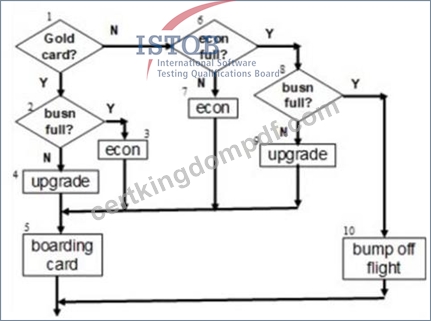
If you are flying with an economy ticket, there is a possibility that you may get upgraded to business class, especially if you hold a gold card in the airline's frequent flier program. If you don't hold a gold card, there is a possibility that you will get 'bumped' off the flight if it is full when you check in late.
This is shown in the control flow graph below. Note that each box (i.e., statement, decision) has been numbered.
Three tests have been run:
Test 1: Gold card holder who gets upgraded to business class
Test 2: Non-gold card holder who stays in economy
Test 3: A person who is bumped from the flight
What is the level of decision coverage achieved by these three tests?
- A. 67%
- B. 75%
- C. 60%
- D. 80%
Answer: A
Explanation:
The control flow graph provided illustrates the decision points for an airline's upgrade and boarding process. Decision coverage is a measure of the percentage of decision points executed during testing:
Test 1 covers the decision points: Gold card? (Yes) and Business full? (No).
Test 2 covers: Gold card? (No) and Economy full? (No).
Test 3 covers the decision that leads to being bumped from the flight, which is Economy full? (Yes) and Business full? (Yes).
From the given tests, the decision points for Gold card? (No) and Business full? (No) are not tested, leaving us with 4 out of 6 decision points covered, which is approximately 67% decision coverage.
NEW QUESTION # 61
You are involved in testing a system in the medical domain. Testing needs to comply with the FDA requirements and is rated as being safety critical. A product risk assessment has been performed and various mitigation actions have been identified. Reliability testing is one of the test types that needs to be performed throughout the development lifecycle.
Based on the information provided, which of the following activities would need to be addressed in the test plan?
- A. Design and execution of test cases for scalability.
- B. Perform a vulnerability scan.
- C. Design and execution of specific tests that evaluate the software's tolerance to faults in terms of handling unexpected input values.
- D. Testing whether the installation/de-installation can be completed.
Answer: C
Explanation:
In the context of safety-critical systems, particularly in the medical domain, reliability is of utmost importance. For such systems, it is crucial to ensure that the software can handle unexpected input values and continue to operate without failure. This is essential to ensure patient safety and compliance with FDA requirements. Vulnerability scans (option A) are more related to security testing, whereas scalability (option C) and installation/de-installation (option D) are important but not specifically related to the reliability and safety criticality of the system in the medical domain.
NEW QUESTION # 62
You are working on a project to develop an application that allows users to collaborate via bespoke, online whiteboards. The first release, delivering core functionality, highlighted misunderstandings of the user stories between testers, developers and the product owner during sprint development Since that release, the developers have agreed to implement a TDD approach for future software development.
Creation of the product backlog for the second release is underway and you have recommended to the project stakeholders that an atdd approach be adopted for the backlog's user stories. What would be a GOOD REASON for making this recommendation?
SELECT ONE OPTION
- A. The team wants to start using BDD and therefore atdd must also be used
- B. TDD can only work effectively when an ATDD approach is used for the user stories use of attd examples will help address the misunderstandings encountered in release 1
- C. The test strategy states that automation shall be used to minimize effort for execution of acceptance tests
Answer: B
Explanation:
Adopting an Acceptance Test-Driven Development (ATDD) approach can be particularly beneficial in scenarios where previous releases have suffered from misunderstandings among the development team and stakeholders regarding user story requirements. ATDD involves creating executable specifications before coding begins, which clarifies expectations and ensures alignment across the team. This method helps prevent issues seen in earlier stages by providing a clear, agreed-upon criteria for acceptance, thereby reducing the chances of future misunderstandings .
NEW QUESTION # 63
Which of the following are activities that the Technical Test Analyst performs when setting up a test automation project?
1.Schedule the manual testing
2.Define interface requirements between tools
3.Perform a code review on the functional specifications
4.Determine whether to use a rule-dnven approach
5.Tram the test analysts to use and supply the data
- A. 3. 5
- B. 1.2
- C. 1.4
- D. 2,5
Answer: D
Explanation:
In setting up a test automation project, the Technical Test Analyst performs activities such as defining interface requirements between tools and training the test analysts to use and supply the data. These activities are crucial for ensuring that the automation tools are effectively integrated and that the team is capable of utilizing these tools efficiently.
NEW QUESTION # 64
You are defining the test approach for an Agile project developing a system to control traffic lights at busy road junctions. The system will use sensors to measure traffic density and flow rates, optimizing traffic flow.
While safety-critical, a risk assessment has deemed the project's risk level as low due to the team's expertise.
Which option below represents the BEST test approach for this project?
Key to symbols:
* + (highly recommended)
* (recommended)
* o (neutral/optional)
* * (not recommended)
* - (not to be used)
SELECT ONE OPTION
- A. 0
- B. 1
- C. 2
- D. 3
Answer: A
Explanation:
In the scenario described, the project involves developing a system to control traffic lights at busy road junctions, focusing on safety-critical operations but deemed low-risk due to the team's high level of expertise.
Option B (4), characterized by (recommended) for Test Automation and + (highly recommended) for Exploratory Testing (manual) with (recommended) for Black-box Testing, is the most fitting for this project because:
* Test Automation (Recommended): For a system managing traffic lights, automated tests can efficiently handle repetitive testing of scenarios involving various traffic densities and flow rates, ensuring consistent and thorough checking of system responses under controlled conditions.
* Exploratory Testing (Highly Recommended): Given the critical nature of the system, exploratory testing allows testers to creatively challenge the system beyond pre-defined test cases, identifying potential real-world issues that might not be evident in scripted testing. This is particularly vital in safety-critical systems where unexpected behavior could have severe consequences.
* Black-box Testing (Recommended): Black-box testing will ensure that the system meets its external specifications and behaves correctly as perceived from the outside, without the testers needing to know the internal workings. This is essential for verifying that the system's functionality aligns with its intended use in real-world traffic scenarios.
This approach, combining thorough automation with exploratory insights and specification-based validation, supports the project's safety-critical nature while leveraging the team's expertise to manage the identified low risk .
NEW QUESTION # 65
Consider the following fault attack:
* Force all possible incoming errors from the software/operating system interfaces to the application.
Which of the following is the kind of failure you are looking for when using this attack?
- A. Application crashes due to a lack of portability.
- B. Application miscalculates total monthly balance due on credit cards.
- C. Application crashes when the network is unavailable.
- D. Application crashes when unsupported characters are pasted into an input field.
Answer: D
Explanation:
The fault attack described involves forcing all possible incoming errors from software/operating system interfaces. The type of failure being sought is one where the application does not handle erroneous or unexpected input correctly, which can lead to crashes or other unintended behavior. Thus, an application crash when unsupported characters are pasted into an input field is a typical failure that this kind of fault attack would aim to uncover.
NEW QUESTION # 66
A major Caribbean bank typically develops their own banking software using an Agile methodology.
However, for some specific components COTS software is acquired and used. The bank does not want to create a dependency on any external COTS supplier.
As part of the test approach, portability testing will be performed. Which portability sub-characteristic is especially relevant for the Caribbean bank?
- A. Co-existence
- B. In stall ability
- C. Replaceability
- D. Adaptability
Answer: C
Explanation:
Portability testing is concerned with how well software can be transferred from one environment to another. In the context of a bank using COTS (Commercial Off-The-Shelf) software, the sub-characteristic of replaceability becomes particularly relevant. This is because the bank does not want to create a dependency on any external COTS supplier, meaning it should be able to replace the software with another product without significant effort or operational disruption. Replaceability ensures that if needed, the bank can switch to different software, thereby mitigating the risk of supplier dependency.
NEW QUESTION # 67
......
CTAL-TTA Dumps and Exam Test Engine: https://www.certkingdompdf.com/CTAL-TTA-latest-certkingdom-dumps.html