


Best Way To Study For Cisco 300-420 Exam Brilliant 300-420 Exam Questions PDF
Updated Verified Pass 300-420 Exam - Real Questions and Answers
Cisco 300-420 exam tests the candidates' abilities to design and implement advanced enterprise-level network solutions using technologies such as virtualization, automation, security, and network assurance. 300-420 exam also covers topics related to network design methodologies, network services, and network topology. 300-420 exam is intended for network architects, network engineers, and other IT professionals who are responsible for designing and implementing enterprise-level networks.
NEW QUESTION # 110
An architect must develop a campus network solution that includes:
logically segmented and isolated networks
ability to communicate between network segments when required
support for overlapping IP addresses
widely available technologies to avoid purchasing specialized equipment Which solution must the architect select?
- A. vPC with HSRP
- B. VSS with IGP
- C. 802.1Q with HSRP
- D. VRF-Lite with OSPF
Answer: D
NEW QUESTION # 111
An engineer is designing a QoS policy that queues excess packets for later transmission. Which mechanism must be included in the design?
- A. RED
- B. shaping
- C. WRED
- D. policing
Answer: B
NEW QUESTION # 112
Instructions
The main screen consists of two parts; the Main scenario and the Topology tabs. The main scenario describes TSHOOT.com test bed. The Topology tabs allow you to display the appropriate and select the trouble ticket.
To complete the item, you will first need to familiarize yourself with the TSHOOT.com test bed by clicking on the master scenario first and then the topologies tabs. Once you are familiar with the test bed and the topologies, you should start evaluating the trouble ticket. You will be presented with a Trouble Ticket scenario that will describe the fault condition. You will need to determine on which device the fault condition is located, to which technology the fault condition is related, and the solution to each trouble ticket. This will be done by answering three questions.
Ticket Selection
To begin, click on the Ticket on the Topology tabs.
Please note. Some of the questions will require you to use the scroll bar to see all options.
Fault Isolation
Read the ticket scenario to understand the fault condition.
Open the appropriate topology, based upon the ticket scenario.
Open the console of the desired device by clicking on that device in the topology, based upon your troubleshooting methodology.
Use the supported show, ping and trace commands to begin your fault isolation process.
Move to other devices as need by clicking on those devices within the topology.
Fault Identification
The trouble ticket will include three questions that you will need to answer:
1. Which device contains the fault
2. Which technology the fault condition is related to
3. What is the solution to the issue
To advance to the next question within the ticket click on "Next Question".
When you click "DONE", the trouble ticket will turn RED and will no longer be accessible.
You may also use the "Previous Question" button to review questions within that specific ticket.
To complete a trouble ticket, answer all three questions and click "DONE". This will store your response to the questions. Do not click on "DONE" unless you have answered all questions within the ticket.
Item Completion
Click the NEXT button on the bottom of the screen once a ticket is RED. This action moves you to the next item.
Scenario
The company has created the test bed network shown in the layer 2 and layer 3 topology exhibits.
This network consists of four routers, two layer 3 switches and two layer 2 switches.
In the IPv4 layer 3 topology, R1, R2, R3, and R4 are running OSPF with an OSPF process number 1.
DSW1, DSW2 and R4 are running EIGRP with an AS of 10. Redistribution is enabled where necessary.
R1 is running a BGP AS with a number of 65001. This AS has an eBGP connection to AS 65002 in the ISP's network. Because the company's address space is in the private range, R1 is also providing NAT translations between the inside (10.1.0.0/16 & 10.2.0.0/16) networks and the outside (209.65.200.0/24) network.
ASW1 and ASW2 are layer 2 switches.
NTP is enabled on all devices with 209.65.200.226 serving as the master clock source.
The client workstations receive their IP address and default gateway via R4's DHCP server. The default gateway address of 10.2.1.254 is the IP address of HSRP group 10 which is running on DSW1 and DSW2.
In the IPv6 layer 3 topology R1, R2, and R3 are running OSPFv3 with an OSPF process number 6. DSW1, DSW2 and R4 are running RIPng process name RIP_ZONE. The two IPv6 routing domains, OSPF 6 and RIPng are connected via GRE tunnel running over the underlying IPv4 OSPF domain. Redistribution is enabled where necessary.
Recently the implementation group has been using the test bed to do a 'proof-of-concept' on several implementations. This involved changing the configuration on one or more of the devices. You will be presented with a series of trouble tickets related to issues introduced during these configurations.
The implementation group has been using the test bed to do a 'proof-of-concept' that requires both Client 1 and Client 2 to access the WEB Server at 209.65.200.241. After several changes to the network addressing, routing scheme, DHCP services, NTP services, and FHRP services, a trouble ticket has been opened indicating that Client 1 cannot ping the 209.65.200.241 address.
Use the supported commands to isolate the cause of this fault and answer the following questions.
What is the solution to the fault condition?
- A. In configuration mode, using the interface range port-channel 13, port-channel 23, then configure switchport trunk allowed vlan 10,200 followed by interface Fastethernet 1/0/1, then no shutdown commands.
- B. In configuration mode, using the interface range port-channel 23, port-channel 24, then configure switchport trunk allowed vlan none followed by switchport trunk allowed vlan 10,20, commands.
- C. In configuration mode, using the interface range port-channel 23, port-channel 24, then configure switchport trunk allowed vlan none followed by switchport trunk allowed vlan 10,20,200 commands.
- D. In configuration mode, using the interface range port-channel 13, port-channel 23, then configure switchport trunk allowed vlan none followed by switchport trunk allowed vlan 10,200 commands.
Answer: D
Explanation:
Solution
Steps need to follow as below:-1.When we check on client 1 & Client 2 desktop we are not receiving DHCP address from R4Ipconfig ----- Client will be getting 169.X.X.X2.On ASW1 port Fa1/0/ 1 & Fa1/0/2 access port VLAN 10 was assigned which is using IPaddress 10.2.1.0/24Sh run ------- & check for running config of int fa1/0/1 & fa1/0/2====================================================interface FastEthernet1/0/1switchport mode accessswitchport access vlan 10interface FastEthernet1/0/2switchport mode accessswitchport access vlan 10
3.We need to check on ASW 1 trunk port the trunk Po13 & Po23 were receiving VLAN 20 &200 but not VLAN
10 so that switch could not get DHCP IP address and was failing to reach IPaddress of Internet4.
Change required:
On ASW1 below change is required for switch-to-switch connectivity..int range portchannel13,portchannel23switchport trunk allowed vlan noneswitchport trunk allowed vlan 10,200
NEW QUESTION # 113
Drag and drop the characteristics from the left onto the Yang model they describe on the right.
Select and Place:
Answer:
Explanation:
NEW QUESTION # 114
A router running ISIS is showing high CPU and bandwidth utilization. An engineer discovers that the router is configured as L1/L2 and has L1 and L2 neighbors. Which step optimizes the design to address the issue?
- A. Configure each interface as either L1 or L2 circuit type
- B. Configure the router to be either L1 or L2
- C. Disable the default behavior of advertising the default route on the L1/L2 router
- D. Make this router a DIS for each of the interfaces
Answer: A
NEW QUESTION # 115
A client is moving to Model-Driven Telemetry and requires periodic updates. What must the network architect consider with this design?
- A. The primary push update is sent immediately and cannot be delayed.
- B. Updates that contain changes within the data are sent only when changes occur.
- C. Empty data subscriptions do not generate empty update notifications.
- D. Periodic updates include a full copy of the data that is subscribed to.
Answer: D
Explanation:
Explanation
Periodic updates contain a full copy of the subscribed data element or table for all supported transport protocolshttps://www.cisco.com/c/en/us/td/docs/ios-xml/ios/prog/configuration/166/b_166_programmability_cg/
NEW QUESTION # 116
Which design consideration must be made when dual WAN Edge routers are deployed at a branch site?
- A. Use BGP AS-path prepending to influence egress traffic and use MED to influence ingress traffic from the branch.
- B. HSRP priorities must match the OMP routing policy to prefer one WAN Edge over the other.
- C. Configure BFD between WAN Edge routers to detect sub-second link failures.
- D. Traffic must be symmetrical as it egresses the WAN Edges and returns from remote sites for DPI to function properly.
Answer: A
Explanation:
Section: WAN for Enterprise Networks
NEW QUESTION # 117
A network solution is being designed for a company that connects to multiple Internet service providers. Which Cisco proprietary BGP path attribute will influence outbound traffic flow?
- A. AS Path
- B. Weight
- C. Community
- D. MED
- E. Local Preference
Answer: B
NEW QUESTION # 118
Which two functions is the Cisco SD-Access Edge Node responsible for? (Choose two.)
- A. Act as anycast layer 3 gateway
- B. Map users to virtual network
- C. Route and transport IP traffic
- D. Advertise EID subnets
- E. Act as LISP proxy tunnel router
Answer: A,B
Explanation:
Explanation
https://www.cisco.com/c/en/us/td/docs/solutions/CVD/Campus/cisco-sda-design-guide.html#EdgeNode
NEW QUESTION # 119
An engineer must design a multicast network for a financial application. Most of the multicast sources also receive multicast traffic (many-to-many deployment model). To better scale routing tables, the design must not use source trees. Which multicast protocol satisfies these requirements?
- A. MSDP
- B. PIM-SSM
- C. PIM-SM
- D. BIDIR-PIM
Answer: C
NEW QUESTION # 120
Which control-plane technology allows the same subnet to exist across multiple network locations?
- A. LISP
- B. ISE mobility services
- C. VXLAN
- D. FabricPath
Answer: A
Explanation:
https://www.cisco.com/c/en/us/td/docs/solutions/CVD/Campus/cisco-sda-design-guide.html
NEW QUESTION # 121
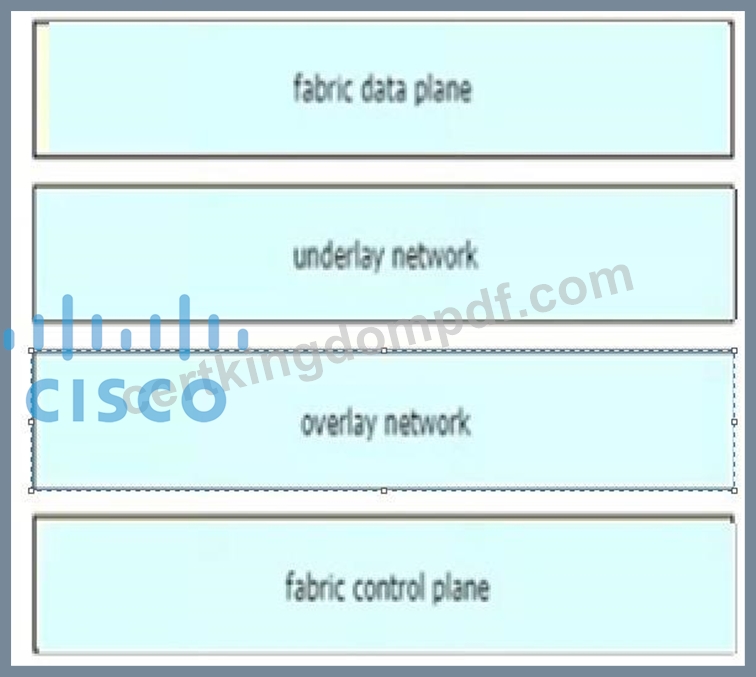
Drag and drop the components in a Cisco SD-Access architecture from the left onto their descriptions on the right.
Answer:
Explanation:
NEW QUESTION # 122
An engineer must design an addressing plan for a small business using a single /24 network. Each department must have its own subnet. Drag and drop the subnets from the left onto the departments requirements that they fulfill on the right. Not all options are used.
Answer:
Explanation:
NEW QUESTION # 123
Refer to the exhibit.
Which solution decreases the EIGRP convergence time?
- A. Enable stub routing on the spokes
- B. Enable subsecond timers
- C. Increase the hold time value
- D. Increase the dead timer value
Answer: A
NEW QUESTION # 124
Drag and drop the components in a Cisco SD-Access architecture from the left onto their descriptions on the right.
Answer:
Explanation:
NEW QUESTION # 125
Refer to the exhibit. An architect must design a solution to connect the two ASs. To optimize bandwidth, the design will implement load sharing between router R6 and router R4. Which solution should the design include?
- A. Use next-hop-serf attributes only for routes that are learned from eBGP peers.
- B. Use update-source to specify the Loopback interface.
- C. Configure the eBGP TTL to support eBGP multihop.
- D. Use maximum-paths to install multiple paths in the routing table.
Answer: D
NEW QUESTION # 126
A customer's current Layer 2 infrastructure is running Spanning Tree 802.1d, and all configuration changes are manually implemented on each switch. An architect must redesign the Layer 2 domain to achieve these goals:
- A. reduce the time spent on network administration
- B. reduce the impact of topology changes
- C. reduce manual configuration errors
Answer: B,C
Explanation:
Which two solutions should the architect include in the new design? (Choose two.) Implement Rapid PVST+ instead of STP.
Implement MST instead of STP.
Use VTP to propagate VLAN information and to prune unused VLANs.
Configure broadcast and multicast storm control on all switches.
Configure dynamic trunking protocol to propagate VLAN information.
NEW QUESTION # 127
Refer to the exhibit.
Refer to the exhibit A customer requires maximum uptime for the data plane between R1 and R3 running OSPF Which solution must the design include for high availability if the routing process on R2 requires maintenance?
- A. BFD on all routers
- B. graceful restart on all routers
- C. nonstop forwarding on R3 only
- D. nonstop forwarding on R1 and R3
Answer: D
NEW QUESTION # 128
Refer to the exhibit.
Refer to the exhibit. An engineer Is designing a multicampus Layer 3 Infrastructure using EIGRP as the routing protocol. The design must provide quick replies to queries In the event of a downlink, prevent unnecessary queries, and ensure that traffic does not unnecessarily transit the access layer. Which two actions must the engineer take for the network design? (Choose two.)
- A. Configure access layer and core layer switches as stub routers.
- B. Configure core layer switches as stub routers.
- C. Configure access layer switches to summarize routes to the distribution layer.
- D. Configure distribution layer switches to summarize routes to the core layer.
- E. Configure access layer switches as stub routers.
Answer: D,E
NEW QUESTION # 129
Which consideration must be taken into account when using the DHCP relay feature in a Cisco SD-Access Architecture?
- A. DHCP servers must support Cisco SD-Access extensions to correctly assign IPs to endpoints in an SD-Access fabric with anycast gateway.
- B. A DHCP server must be enabled on the border nodes to allow subnets to span multiple fabric edges.
- C. DHCP Option-82 must be enabled to map the circuit IP option to the access fabric node where the DHCP discover originated.
- D. DHCP-relay must be enabled on fabric edge nodes to provide the correct mapping of DHCP scope to the local anycast gateway.
Answer: C
Explanation:
Explanation
https://www.cisco.com/c/en/us/td/docs/cloud-systems-management/network-automation-and-management/dna-c
NEW QUESTION # 130
......
To prepare for the Cisco 300-420 exam, candidates can enroll in training courses offered by Cisco, such as Designing Cisco Enterprise Networks (ENSLD) v1.0. They can also use study materials such as books, practice tests, and online resources to supplement their learning. Candidates should have a good understanding of networking concepts, routing and switching protocols, and network design principles before attempting 300-420 exam.
Cisco 300-420 exam is a challenging certification exam that requires a significant amount of preparation and study. To pass the exam, you will need to have a deep understanding of Cisco Enterprise Network design principles and be able to apply this knowledge to solve complex network design problems. You will also need to be familiar with the latest networking technologies and industry trends, as the exam is designed to test your knowledge of the latest best practices and design principles.
Updated PDF (New 2023) Actual Cisco 300-420 Exam Questions: https://www.certkingdompdf.com/300-420-latest-certkingdom-dumps.html
Dumps Moneyack Guarantee - 300-420 Dumps Approved Dumps: https://drive.google.com/open?id=1EQWwI0W7lWuGbnhialGV9Rayvd7aOO8E