


Knowing your weaknesses is the fastest route to fixing them. The online test engine for the Microsoft Querying Data with Transact-SQL exam points out your mistakes and reminds you to review them daily, and CertkingdomPDF pairs it with 205 verified practice questions.
Microsoft 070-761 Exam Overview:
| Certification Vendor: | Microsoft |
|---|---|
| Exam Name: | Querying Data with Transact-SQL |
| Exam Number: | 70-761 |
| Real Exam Qty: | 40-60 |
| Exam Format: | Multiple choice, Review screen, Drag and drop, Hot area, Active screen, Multiple response, Build list, Short answer |
| Exam Price: | $165 USD |
| Certificate Validity Period: | No fixed expiration for earned legacy certification; exam retired on January 31, 2021 |
| Passing Score: | 700/1000 |
| Available Languages: | Chinese (Simplified), English, Japanese, Portuguese (Brazil), Russian, Chinese (Traditional), German, French |
| Exam Duration: | 120 minutes |
| Related Certifications: | MCSA: SQL 2016 Database Development |
| Sample Questions: |  |
| Exam Way: | Pearson VUE testing center or online proctored delivery when available; the exam is retired and no longer available for registration. |
| Pre Condition: | No formal prerequisite exam. Intended for SQL Server database administrators, system engineers, and developers with two or more years of experience writing Transact-SQL queries. Exam 70-762 was also required to earn MCSA: SQL 2016 Database Development. |
Microsoft 070-761 Exam Syllabus Topics:
| Section | Weight | Objectives |
|---|---|---|
| Query data with advanced Transact-SQL components | 30-35% | - Query data by using table expressions
|
| Program databases by using Transact-SQL | 25-30% | - Implement error handling and transactions
|
| Manage data with Transact-SQL | 40-45% | - Modify data
|
070-761 Exam Questions Answered
After each practice session, the online test engine records which questions you answered incorrectly and reminds you to revisit them in your next round. Reviewing your own mistakes daily shows you clearly where your weaknesses and strengths lie, so every session builds on the last instead of starting from scratch.
The Microsoft Querying Data with Transact-SQL exam contains 40-60 questions, and you will have 120 minutes minutes to complete them. Practicing the full volume under a timer is the closest thing to rehearsing the real exam.
Yes. The online test engine lets you set a time limit for each practice session, so you can train yourself to allocate minutes per question the way you will need to in the real 070-761 exam. Working under a clock at home makes time pressure on exam day feel routine rather than alarming.
The Microsoft Querying Data with Transact-SQL exam requires a score of 700/1000 to pass, and the official registration fee is $165 USD. Since the exam fee is a real investment, thorough preparation is the most practical way to protect it.
No formal prerequisite exam. Intended for SQL Server database administrators, system engineers, and developers with two or more years of experience writing Transact-SQL queries. Exam 70-762 was also required to earn MCSA: SQL 2016 Database Development.
You can confirm the current eligibility requirements on the official 070-761 exam page before you register.
The Microsoft Querying Data with Transact-SQL practice questions are organized around the official exam objectives. Key topics include:
- Manage data with Transact-SQL (40-45%)
- Query data with advanced Transact-SQL components (30-35%)
- Program databases by using Transact-SQL (25-30%)
Daily practice mapped to these topics keeps your preparation balanced across the whole syllabus.
This package includes 205 practice questions for the Microsoft Querying Data with Transact-SQL exam. Every answer is verified by an experienced team of experts, so you can trust what you study.
Microsoft Querying Data with Transact-SQL Sample Questions:
Note: This question is part of a series of questions that present the same scenario. Each question in the series contains a unique solution that might meet the stated goals. Some question sets might have more than one correct solution, while others might not have a correct solution.
After you answer a question in this section. You will NOT be able to return to it. As a result, these questions will not appear in the review screen.
You have a database that tracks orders and deliveries for customers in North America. The database contains the following tables:
Sales.Customers
Application.Cities
Sales.CustomerCategories
Your company is developing a new social application that connects customers to each other based on the distance between their delivery locations.
You need to write a query that returns the nearest customer.
Solution: You run the following Transact-SQL statement:
The variable @custID is set to a valid customer.
Does the solution meet the goal?
- A. Yes
- B. No
Correct Answer: A 🗳️
Explanation: Only visible for CertkingdomPDF members. You can sign-up / login (it's free).
You have a database that includes the following tables:
You need to create a list of all customer IDs and the date of the last order that each customer placed. If the customer has not placed any orders, you must return the date January 1, 1900. The column names must be CustomerID and LastOrderDate.
Which four Transact-SQL segments should you use to develop the solution? To answer, move the appropriate Transact-SQL segments from the list of Transact-SQL segments to the answer area and arrange them in the correct order.
Correct Answer:

Explanation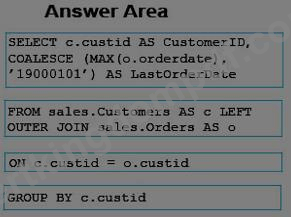
Box 1: SELECT..COALESCE...
The COALESCE function evaluates the arguments in order and returns the current value of the first expression that initially does not evaluate to NULL.
Box 2: ..LEFT OUTER JOIN..
The LEFT JOIN (LEFT OUTER JOIN) keyword returns all rows from the left table (table1), with the matching rows in the right table (table2). The result is NULL in the right side when there is no match. A customer might have no orders so the right table must be allowed have a NULL value.
Box 3: ON c.custid = o.custid
We JOIN on the custID column, which is available in both tables.
Box 4: GROUP BY c.custid
References:
https://technet.microsoft.com/en-us/library/ms189499(v=sql.110).aspx
http://www.w3schools.com/sql/sql_join_left.asp
You need to create a database object that meets the following requirements:
* accepts a product identifies as input
* calculates the total quantity of a specific product, including quantity on hand and quantity on order
* caches and reuses execution plan
* returns a value
* can be called from within a SELECT statement
* can be used in a JOIN clause
What should you create?
- A. a memory-optimized table that has updated statistics
- B. an extended stored procedure
- C. a user-defined table-valued function
- D. a user-defined stored procedure that has an OUTPUT parameter
Correct Answer: C 🗳️
You are creating a database solution to track sales achievements of your training courses. You run the following statements:
You plan to add courses to a table named HighlightedCourses. You must add courses that have been delivered to more than 100 participants only.
If the total number of participants for a course is lower than 100, the course must not be added to the HighlightedCourses table. In addition, an error message must be displayed and remaining Transact-SQL code must not run.
How should you complete the Transact-SQL statement? To answer, select the appropriate Transact-SQL segments in the answer area.
NOTE: Each correct selection is worth one point.
Correct Answer:

Explanation
Box 1: THROW
TRHOW raises an exception and transfers execution to a CATCH block of a TRY...CATCH construct.
If a TRY...CATCH construct is not available, the statement batch is terminated. The line number and procedure where the exception is raised are set.
Box 2: IF (@TotalParticipants < 100)
You are building a stored procedure that will update data in a table named Table1 by using a complex query as the data source.
You need to ensure that the SELECT statement in the stored procedure meets the following requirements:
* Data being processed must be usable in several statements in the stored procedure.
* Data being processed must contain statistics.
What should you do?
- A. Insert the data into a table variable, and then update Table1 from the table variable.
- B. Insert the data into a temporary table, and then update Table1 from the temporary table.
- C. Update Table1 by using a common table expression (CTE).
- D. Place the SELECT statement in a derived table, and then update Table1 by using a JOIN to the derived table.
Correct Answer: B 🗳️
Explanation: Only visible for CertkingdomPDF members. You can sign-up / login (it's free).
Viewing page 1 out of 41 pages.
Viewing questions 1-5 out of 205 questions.


 Haley
Haley 
 Borg
Borg  Hogan
Hogan 
 Rock
Rock 
 Wythe
Wythe  Conrad
  Mag
Mag  Brook
Brook  Hannah
  Evelyn
  Jo
Jo  Archer
  Elvis
Elvis  Jim
Jim  Diana
Diana  Hunter
  Owen
Owen 


