


In the cyber age, proving your ability takes more than saying you have it. The ASCP MEDICAL LABORATORY TECHNICIAN - MLT(ASCP) credential is how IT workers demonstrate skill, and CertkingdomPDF's ASCP-MLT bank — 562 expert-verified practice questions — is how you prepare to earn it.
ASCP ASCP-MLT Exam Overview:
| Certification Vendor: | American Society for Clinical Pathology Board of Certification (ASCP BOC) |
|---|---|
| Exam Name: | Medical Laboratory Technician |
| Exam Number: | MLT(ASCP) |
| Related Certifications: | MLS(ASCP) Medical Laboratory Scientist PBT(ASCP) Phlebotomy Technician |
| Exam Format: | Multiple-choice questions (one best answer), Computer Adaptive Testing (CAT) |
| Available Languages: | English |
| Real Exam Qty: | Approximately 100 |
| Certificate Validity Period: | Certification maintenance required (completion of ongoing continuing education every 3 years) |
| Exam Price: | Application fee (USD 235–250, varies by region and international discounts) |
| Passing Score: | Scaled score of ≥ 400 (on 100–999 scale, CAT scoring) |
| Exam Duration: | 150 minutes |
| Sample Questions: |  |
| Exam Way: | Computer-based testing delivered at Pearson VUE test centres |
| Pre Condition: | Completion of accredited MLT program or equivalent education/training OR relevant clinical experience following ASCP BOC eligibility routes |
| Official Syllabus URL: | https://www.ascp.org/boc/explore-credentials/view-all-credentials/MLT |
ASCP ASCP-MLT Exam Syllabus Topics:
| Section | Weight | Objectives |
|---|---|---|
| Topic 1: Immunology | 5–10% | - Principles of immunology - Serologic procedures and immune diseases |
| Topic 2: Microbiology | 15–20% | - Virology and parasitology testing - Bacteriology and mycology procedures |
| Topic 3: Hematology | 20–25% | - Laboratory testing and hemostasis - Physiology and disease states |
| Topic 4: Blood Banking | 15–20% | - Blood group systems and immunology - Blood products and components - Transfusion practice and testing |
| Topic 5: Urinalysis and Other Body Fluids | 5–10% | - Physical and chemical testing - Microscopic analysis and disease correlation |
| Topic 6: Chemistry | 20–25% | - Electrolytes, acid-base, and toxicology - Carbohydrates, lipids, and enzymes |
| Topic 7: Laboratory Operations | 5–10% | - Instrumentation and laboratory mathematics - Quality assessment and safety |
Your ASCP MEDICAL LABORATORY TECHNICIAN - MLT(ASCP) Prep Companion: Facts and Policies
Written terms, promptly honored. If you fail the corresponding exam within 60 days of purchase, send us a scanned copy of your enrollment slip and your official Score Report PDF within two days of the exam date; verified claims receive a full refund within seven days. Exclusions: exams taken within three days of purchase, candidate names that differ from the payer, and free or expired products. Prefer to keep studying? We will exchange your product for two others of equal value at no cost.
Currently, the ASCP-MLT exam requires a passing score of Scaled score of ≥ 400 (on 100–999 scale, CAT scoring) and carries a registration fee of Application fee (USD 235–250, varies by region and international discounts). ASCP can revise either figure, so confirm both on the official site before you schedule.
Because every step is built to save time. The ASCP-MLT bank is carefully made — expert-verified answers across the ASCP MEDICAL LABORATORY TECHNICIAN - MLT(ASCP) objectives, organized for efficient study rather than endless reading. Delivery is instant upon payment, updates are free for 365 days and arrive by email automatically, and our customer service team is online 24 hours to give fast, precise replies whenever a question about the materials comes up. Efficiency is the design goal, from first click to exam day.
The ASCP MEDICAL LABORATORY TECHNICIAN - MLT(ASCP) blueprint is structured around these main domains:
- Chemistry (20–25%)
- Laboratory Operations (5–10%)
- Urinalysis and Other Body Fluids (5–10%)
Further domains complete the official outline; the question bank spans every one.
Per the latest exam information, the ASCP-MLT exam includes Approximately 100 questions and allows 150 minutes minutes. Rehearsing under the same limit at home removes one more unknown from exam day.
Upon successful payment, our system automatically emails the product to your mailbox — typically within about a minute — with an instant download link on screen, so you can start studying right away. If nothing arrives within two hours, check your spam folder and contact our 24-hour support team. Installations are unlimited, and your purchase includes 365 days of free updates delivered by email, plus a 50% renewal discount afterward.
ASCP lists these prerequisites for the ASCP MEDICAL LABORATORY TECHNICIAN - MLT(ASCP): Completion of accredited MLT program or equivalent education/training OR relevant clinical experience following ASCP BOC eligibility routes.
Confirm the current requirements on the official certification page before registering.
ASCP MEDICAL LABORATORY TECHNICIAN - MLT(ASCP) Sample Questions:
The part of the microscope that holds the objective lenses is called the _______________.
- A. objective
- B. fine adjustment
- C. revolving nosepiece
- D. condenser
Correct Answer: C 🗳️
The correct answer is Trichophyton rubrum. The tiny microconidia are lined up in a "birds on the fence" arrangement along the hyphal strand transversing the field of view (yellow arrows). Two pencil-shaped, smooth walled macroconidia are also seen in the lower left field of view (red arrows).
Trichophyton verrucosum may produce microconidia in small quantities. However, they are irregularly arranged with little tendency to line up along the hyphae. Antler hyphae and string bean macroconidia are characteristic of this species.
One of the key characteristics in the identification of Epidermophyton floccosum is the inability of this dermatophyte to produce microconidia. Two to four-celled, club-shaped macroconidia are produced, usually in clusters of two or three.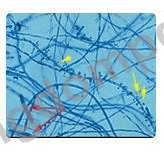
The profusion of tiny microconidia lining up along the hyphae in this photomicrograph is characteristic of which of the following organisms?
- A. Epidermophyton floccosum
- B. Trichophyton verrucosum
- C. Trichophyton rubrum
Correct Answer: C 🗳️
In order to perform a venipuncture on a newly admitted hospital patient, a phlebotomist needs to
- A. Realize that an admitted hospital patient has given implied consent to routine procedures such as phlebotomy.
- B. Verify with the patient's primary care provider that phlebotomy is covered as a routine procedure.
- C. Ask for the patients' written permission to perform the procedure.
- D. Verfity that the patient has specifically name the drawing of blood in the admission process.
Correct Answer: A 🗳️
Hemolytic transfusion reactions seldom occur because the incidence of unexpected antibodies in random patients is relatively low, e.g., 3-5% is sometimes cited.
Being transfused with O Rh negative RBC is irrelvant if you have an unexpected antibody like anti-K or anti-c.
Incompatible red cells may "bleed out" but only if bleeding is brisk. Even then, a hemolytic reaction may occur later once the patient's antibody rebounds and destroys remaining antigen-positive donor red cells.
It's true that some patients have only cold-reactive antibodies that will not react at body temperature. But this does not explain why warm-reactive red cell antibodies cause few reactions Why do so few patients transfused with un-crossmatched red cells in an emergency experience a hemolytic transfusion reaction? Select the one best reason.
- A. They usually receive group O Rh negative red cells; a hemolytic transfusion reaction will never occur if O Rh-negative red cells are transfused.
- B. The incidence of unexpected red cell antibodies is relatively low.
- C. Some patients have cold-reactive antibodies that will not react at body temperature.
- D. They hemorrhage so severely that incompatible donor red cells "bleed out" before a reaction occurs.
Correct Answer: B 🗳️
Standard precautions should be followed:
- A. when a patient is known to be HIV positive
- B. when a patient is known to have hepatitis B
- C. with all patients, at all times
- D. if a patient is in isolation
Correct Answer: C 🗳️
Viewing page 1 out of 113 pages.
Viewing questions 1-5 out of 562 questions.


 Yvonne

 Diana
 Bing

 Winni

 Lynn
 Anastasia
 Bernard
 Miles
 Mick
 Nancy
 Ida
 Jo
 Carr
 Bing


